
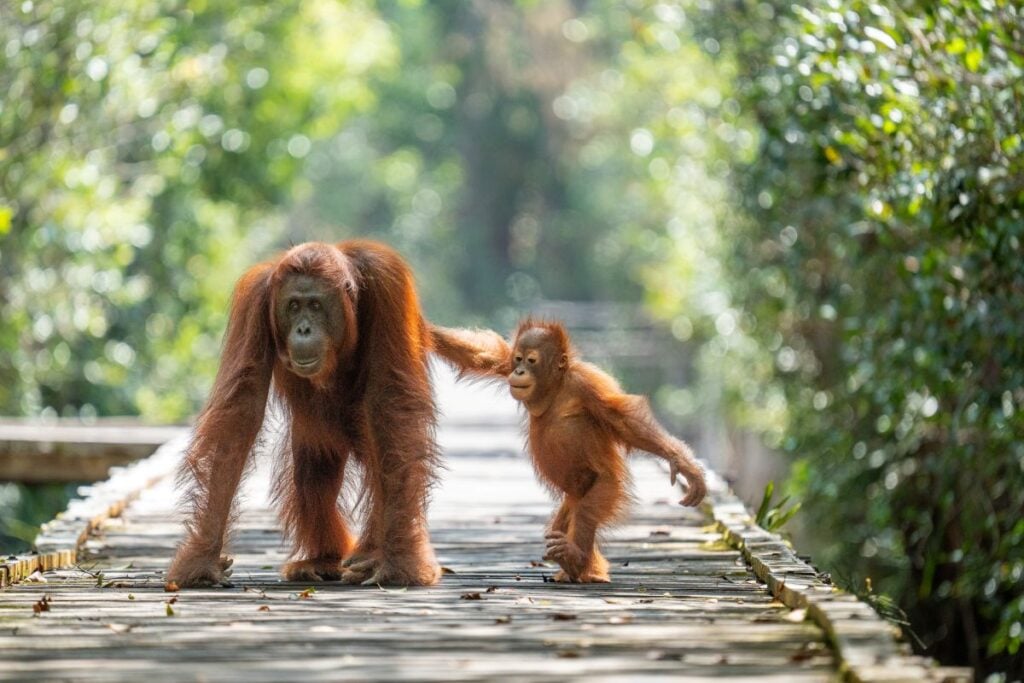
Seeing orangutans in Borneo had been a lifelong dream, so when we started planning our family trip to Indonesia, we knew we couldn’t miss the opportunity. Visiting Borneo with kids turned out to be one of the highlights of our Indonesian adventure. We spent several days exploring Tanjung Puting National Park in Indonesian Borneo (Kalimantan), living aboard a traditional klotok riverboat and searching for orangutans and other wildlife in the rainforest.
Our Borneo orangutan tour was so much more than just visiting the famous feeding stations. We spotted wild orangutans and proboscis monkeys from our boat, explored jungle trails, went on a guided night walk and loved the slower pace of travelling along the river. Having our own private klotok cruise gave us plenty of time to enjoy the wildlife encounters, without feeling rushed from one stop to the next.
Borneo quickly became one of our favourite places to visit in Asia with kids, and we’d highly recommend this experience to other families who love wildlife and adventure. In this post, we share our day-by-day experience in Tanjung Puting National Park, what life aboard a klotok was like with kids and our recommendations for booking a family-friendly Borneo orangutan tour.
This post contains compensated links.
Our 5-Day Borneo with Kids Itinerary
Day 1: Arrival and Tanjung Harapan Feeding Station
Prior to our family trip to Borneo we had spent 5 days in Ubud, Bali with kids. To make it to Pangkalan Bun for the start of our Borneo klotok boat tour, we spent the night at a terrible airport hotel in Semarang. The location was very convenient though and enabled us to easily get to our 8:30 am flight to Pangkalan Bun, Borneo.
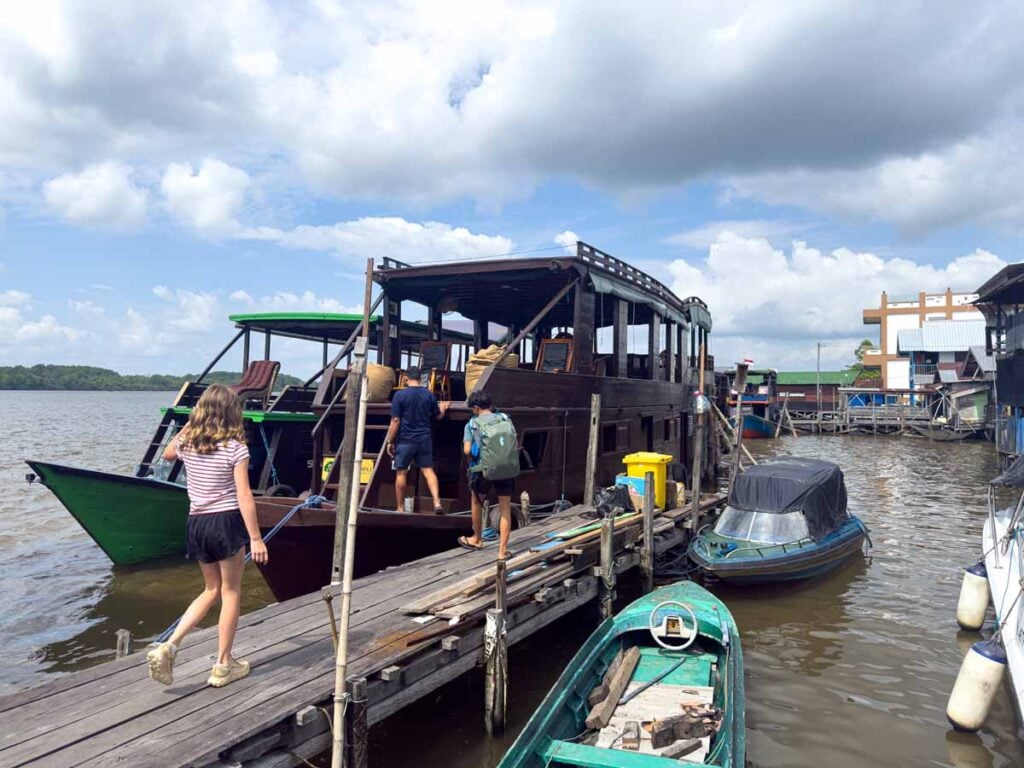
Boarding our Klotok Riverboat
We were met at the Pangkalan Bun airport by our tour guide and were soon on our way up to port. By 10:30 am, we were aboard our klotok boat and on our way! It was a short trip across the Kumai River to enter the much smaller Sekonyer River. We had now entered Tanjung Puting National Park!
Entering Tanjung Puting National Park
Tanjung Puting National Park covers approximately 4,150 square kilometres, making it a vast protected area of rainforest in Indonesian Borneo, and is home to approximately 6,000 orangutans. In addition to the orangutans, there are other jungle creatures such as proboscis monkeys, macaque monkeys, kingfishers and more.
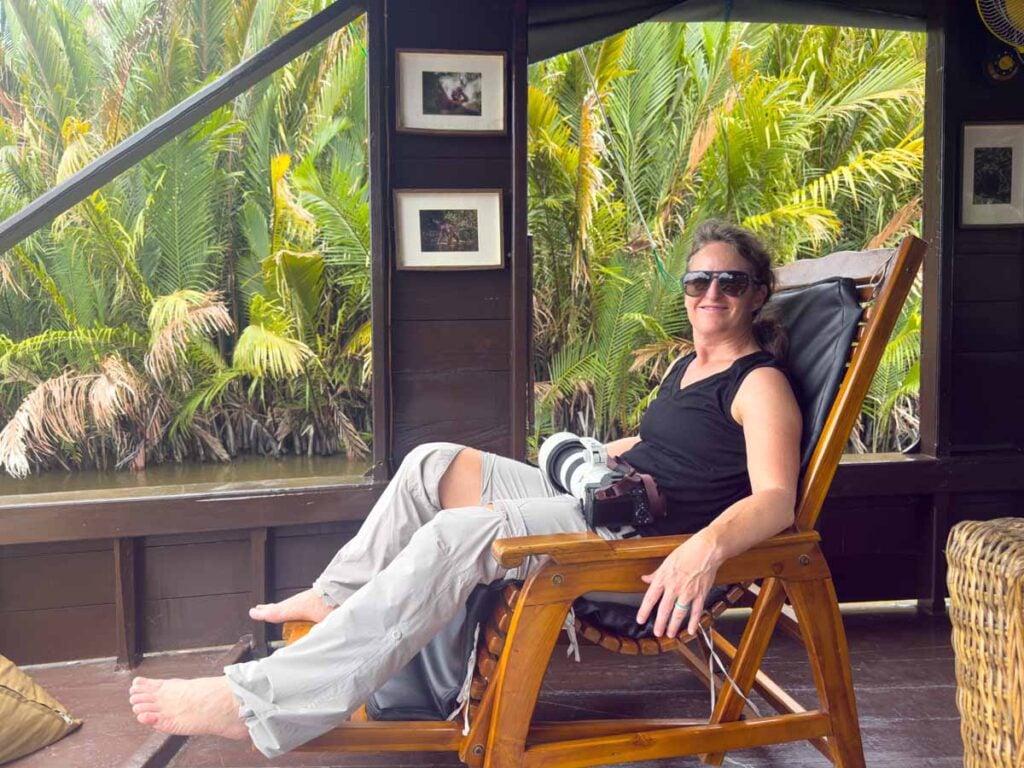
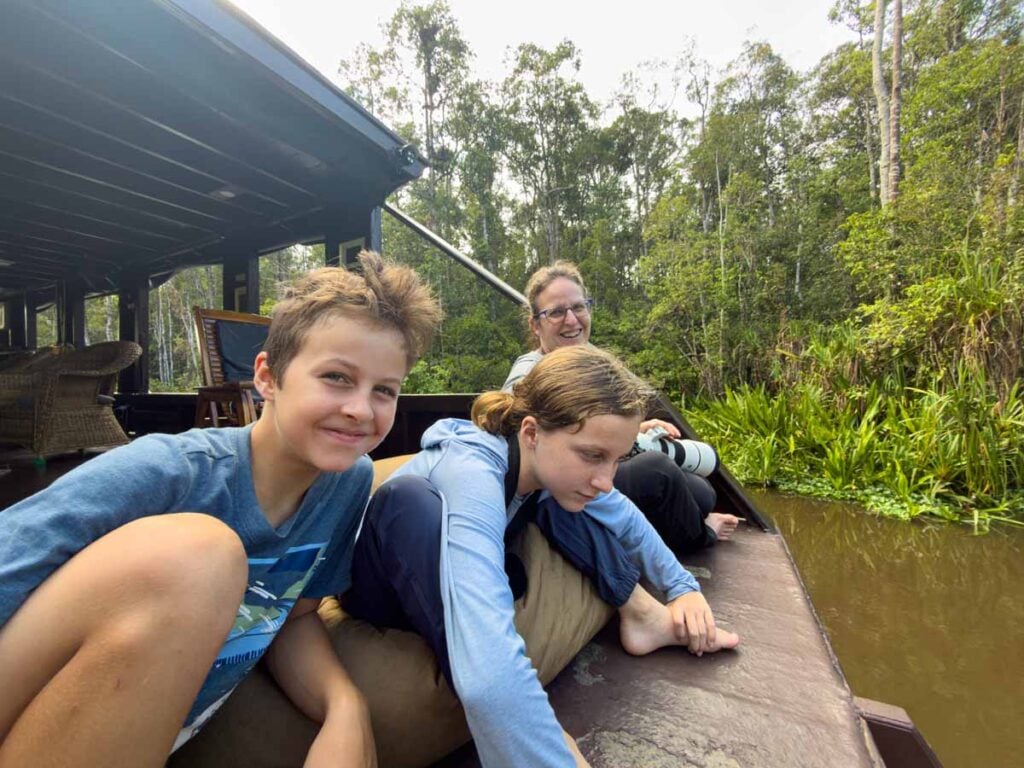
Sitting on the deck of our klotok, feeling the breeze on our faces and watching the jungle along the riverbanks was just what we needed after the crowds in Bali.
Our First Wild Orangutans
Approximately one hour after entering the national park, we were so excited to see our first wild orangutans! A momma orangutan and her very cute baby were in a small tree not far from shore. As sometimes happens with wild animals, they didn’t stay for long and disappeared back into the jungle. A very exciting start to our family trip to Borneo!
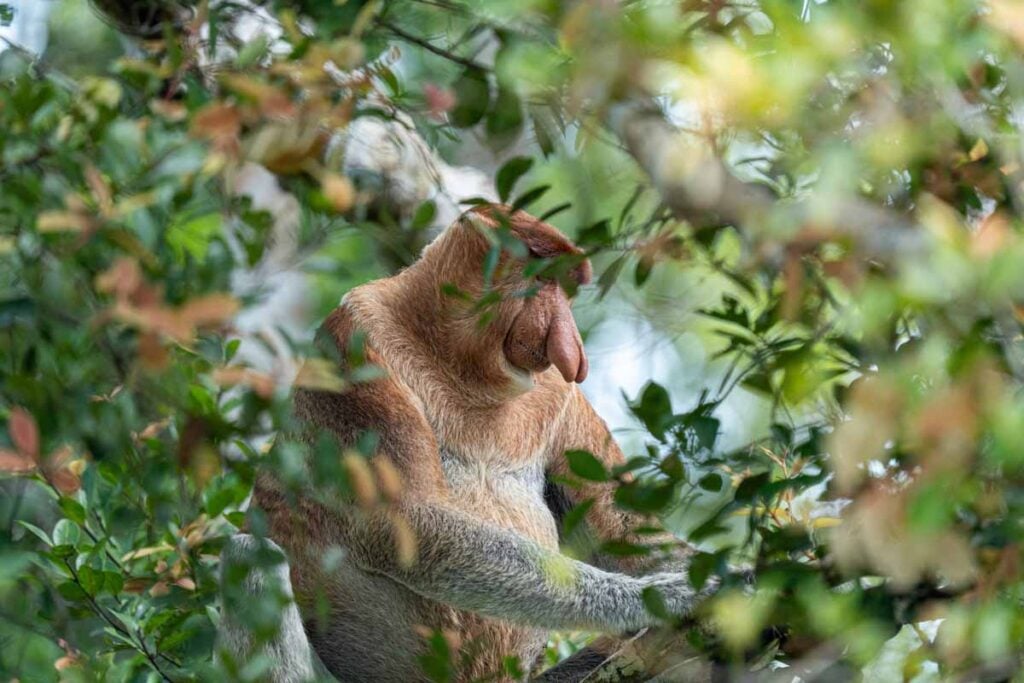
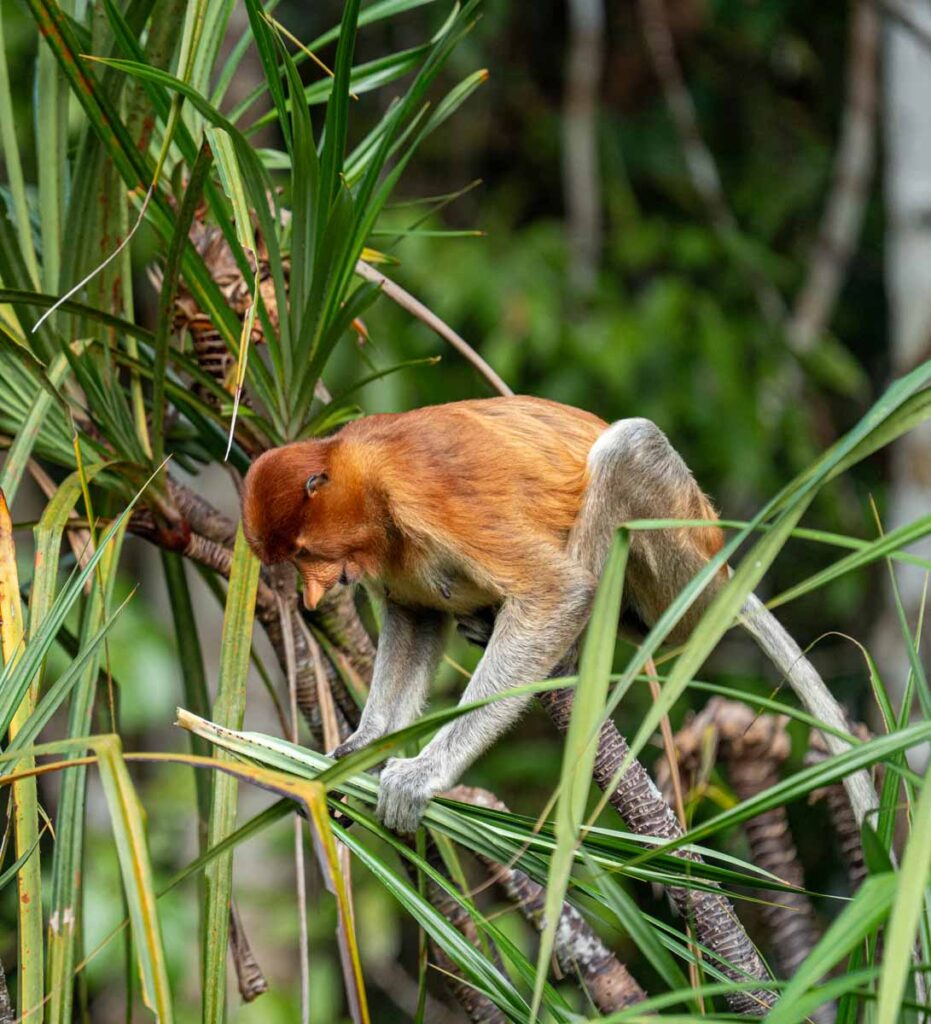
About 10 minutes later we saw our first proboscis monkey. The males of these distinctive monkeys are known for their large, floppy noses. We lucked out, the first one we saw was a sleepy male, just sitting on a nearby tree branch.
Tanjung Harapan Feeding Station
After an amazing first lunch, our boat reached the dock for the first feeding station in Tanjung Puting National Park.
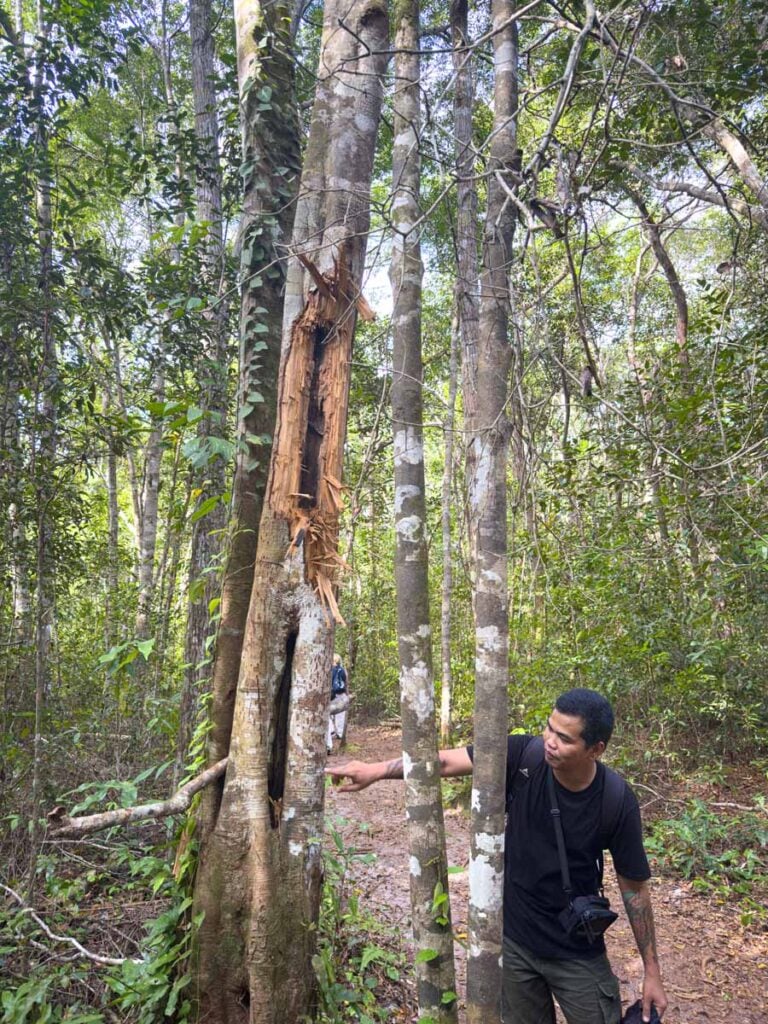
It was an easy 1 km (0.6 mile) walk on a flat, well-groomed trail to reach the Tanjung Harapan Feeding Station. The distinctive buzzing sound of cicadas filled the air. We passed a tree which had recently been torn apart by a sun bear, who ate the hive of stingless honeybees inside. We’d love to see a sun bear!
First Impressions of an Orangutan Feeding Station
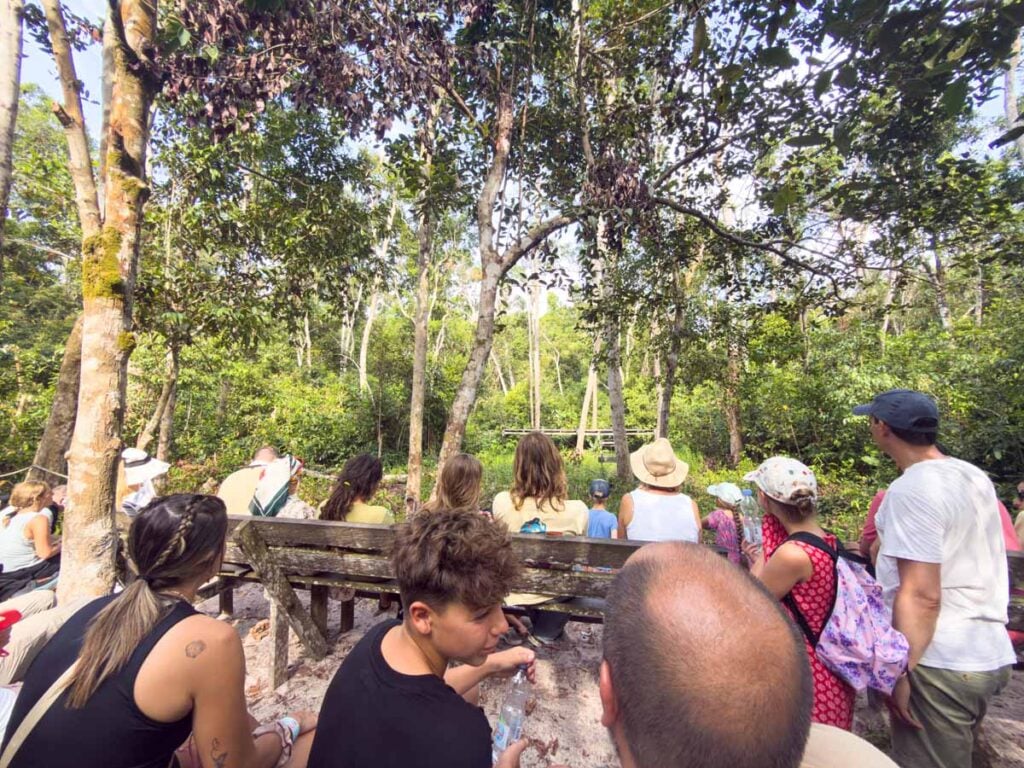
To be honest, we were a little put off when we arrived at our first feeding station. There were two rows of benches, full of other visitors, plus plenty of people standing behind. The benches were facing a large wooden platform about 50 feet away. Our dreams of seeing orangutans in Borneo didn’t consist of watching them eat food on a wooden platform.
But, as we had learned on our trip to Bukit Lawang, Sumatra with kids, to see truly wild orangutans, you need a ton of luck and a great pair of binoculars. Seeing semi-wild orangutans at feeding platforms is a compromise which allows us to see these beautiful creatures up close. Besides, the experience soon got a whole lot better.
An Alpha Male Orangutan Arrives
We had arrived about 40 minutes early as orangutans often show up early. No such luck today. The national park staff arrived at 2:50 pm with two very large bags of bananas and sweet potatoes. They dumped them on the platform and left.
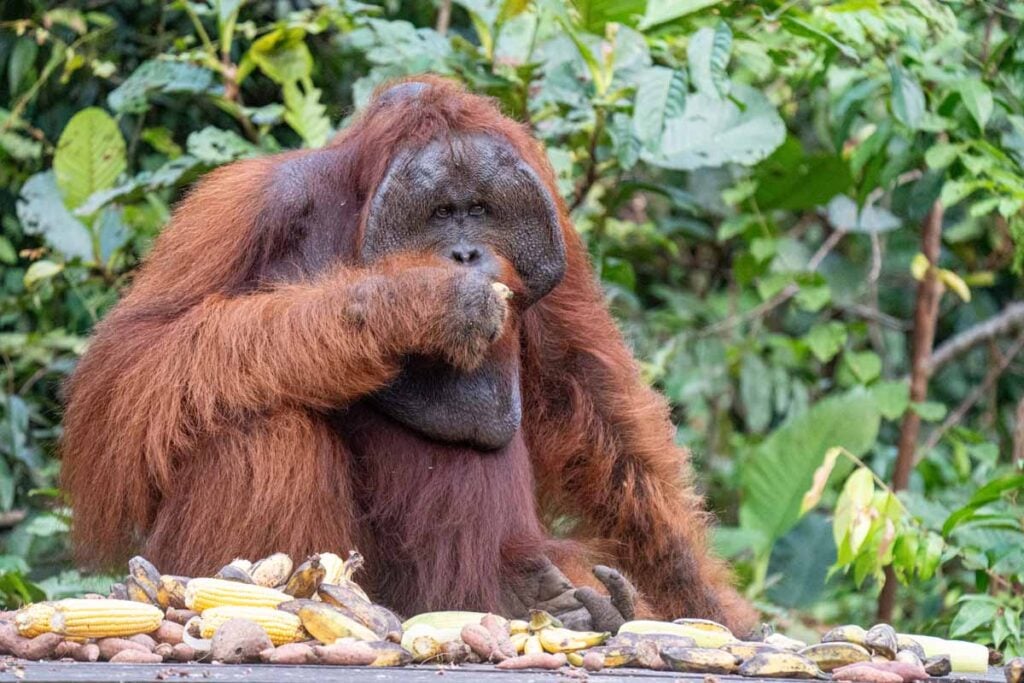
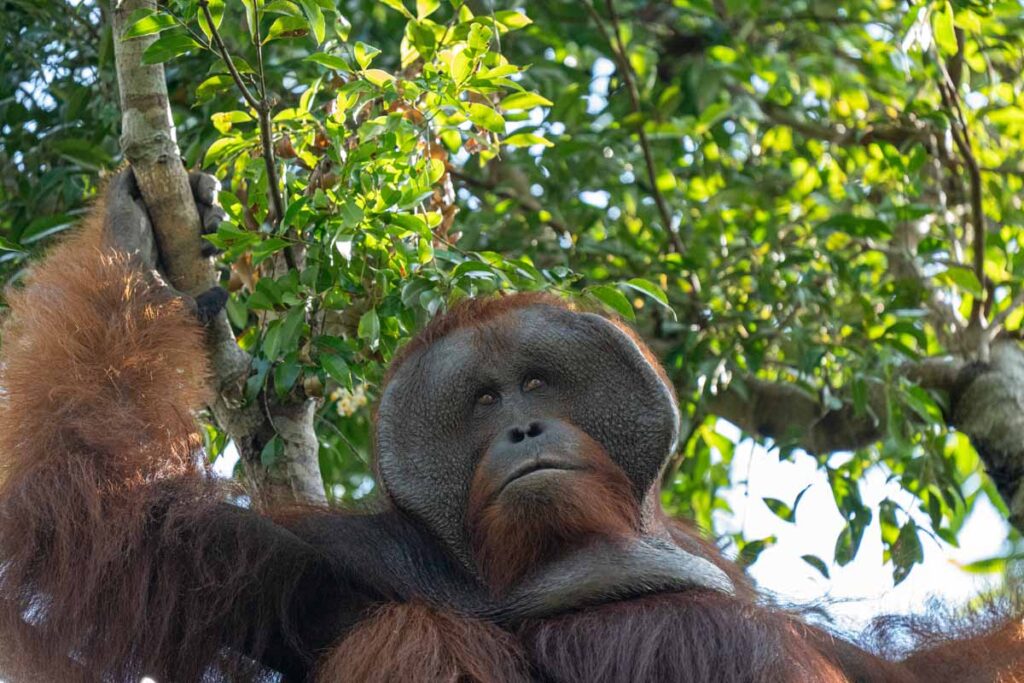
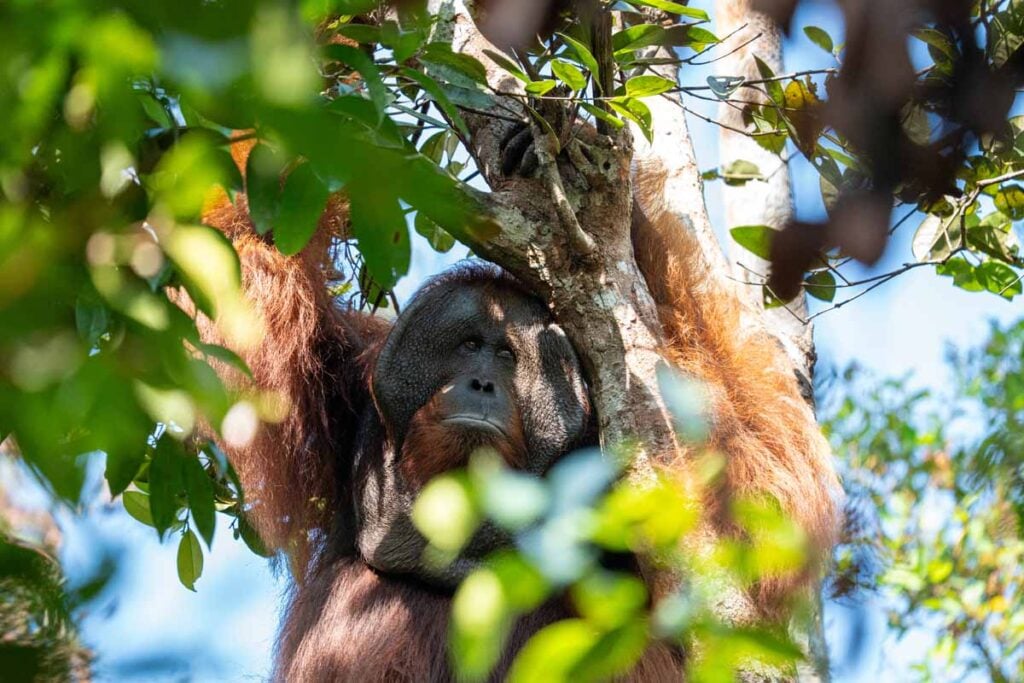
Before long, the alpha male orangutan appeared from the jungle and sat down on the platform and helped himself to the best food. The very large, powerful alpha male orangutans get this privilege. On one hand it was enormously thrilling to see a dominant male orangutan so close, but seeing him feeding on human supplied food felt inauthentic.
The excitement generated by the alpha male’s appearance caused all human consideration to go out the window, as people jockeyed for position for better pictures.
Before long, the dominant female orangutan and her tiny baby appeared on the platform, not too far from the male. He appeared to tolerate her presence eating food.
Many More Orangutans Arrive
It was at this stage that the experience turned around and became so much better. Other orangutans started appearing in the surrounding trees, many of them were also mothers with babies in tow. This did two things:
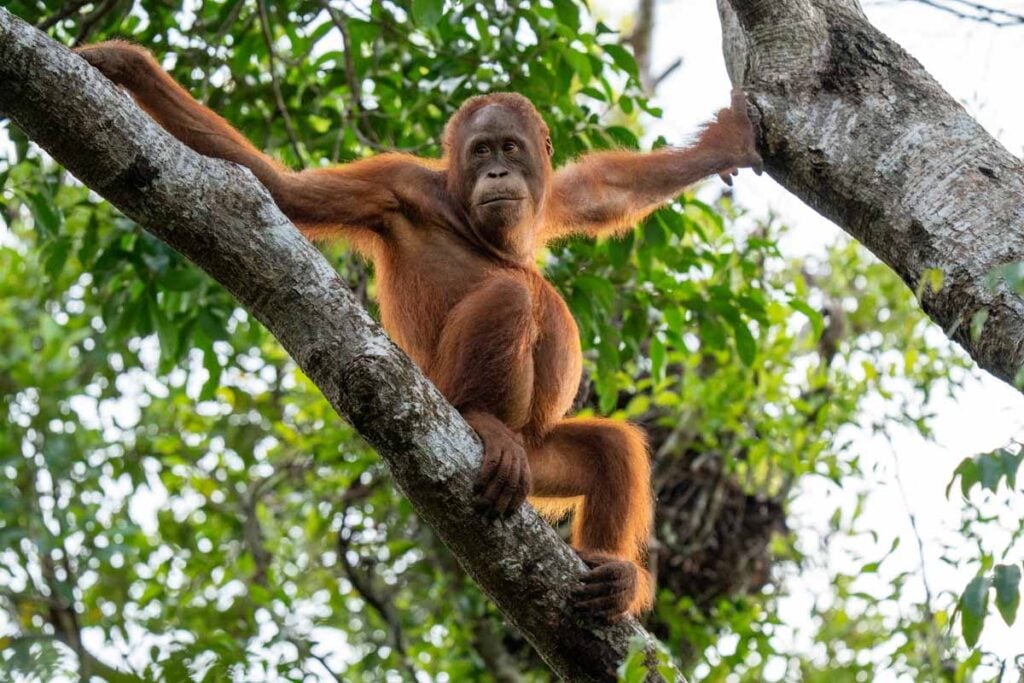
It spread people out, so people were not jostling for position as much and it also allowed for much more natural pictures of the orangutans. I didn’t dream of having pictures of orangutans on a wooden feeding platform, but orangutans in the trees was so much better!
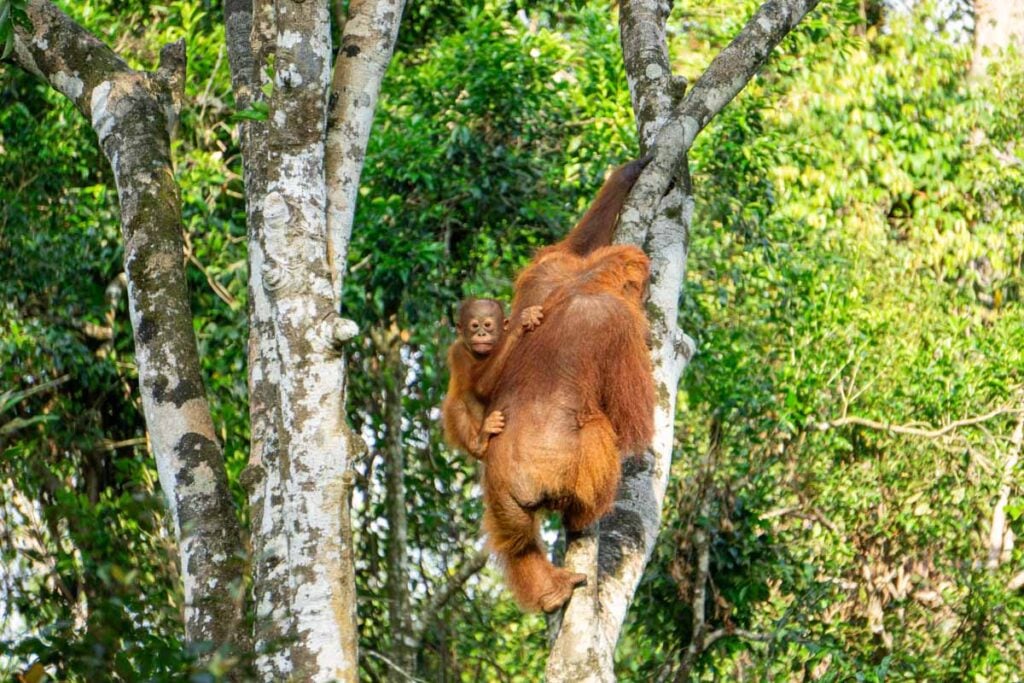
There was a clear pecking order for who got the food. At first it was just the dominant orangutans, but once the male left, the others started taking turns as well. This led to a very loud argument between two females; the sound of the orangutans fighting was very primal.
Despite the disappointing start to the experience, we ended up really enjoying our visit to the feeding station. Once we started getting to enjoy the orangutans in their natural habitat, it became a much better experience.
Back on the Klotok Boat
On our way back to the boat, we passed a large group of macaques. These cheeky monkeys are very cute and wise-looking, but they can be all kinds of trouble too
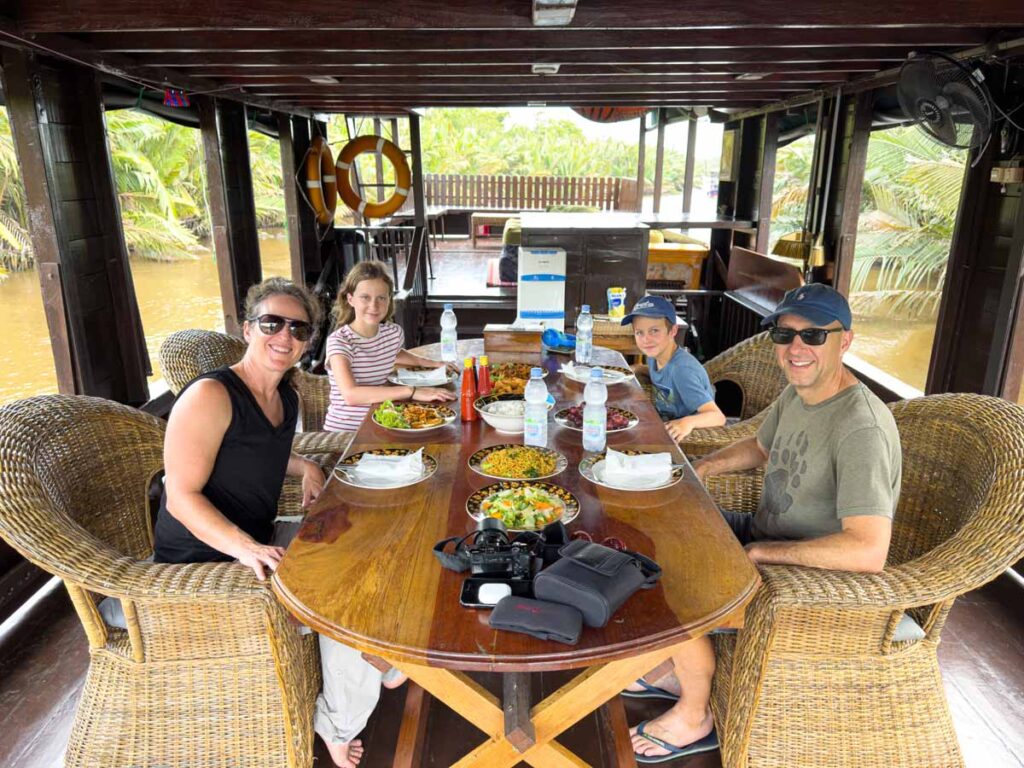
It was quite hot and muggy in the jungle and we all got very sweaty. Upon returning to the boat, our staff greeted us with wet, ice cold towels. Rubbing our faces and the back of our necks with the cold towels was a special treat.
The surprises kept coming. After we had settled back in, the staff brought our sweet jelly drinks and a plateful of fried bananas. Yum!
We had one more sighting of proboscis monkeys at the end of the day. Tanjung Puting National Park is bursting with life; it’s a very special place indeed!
Our Binoculars
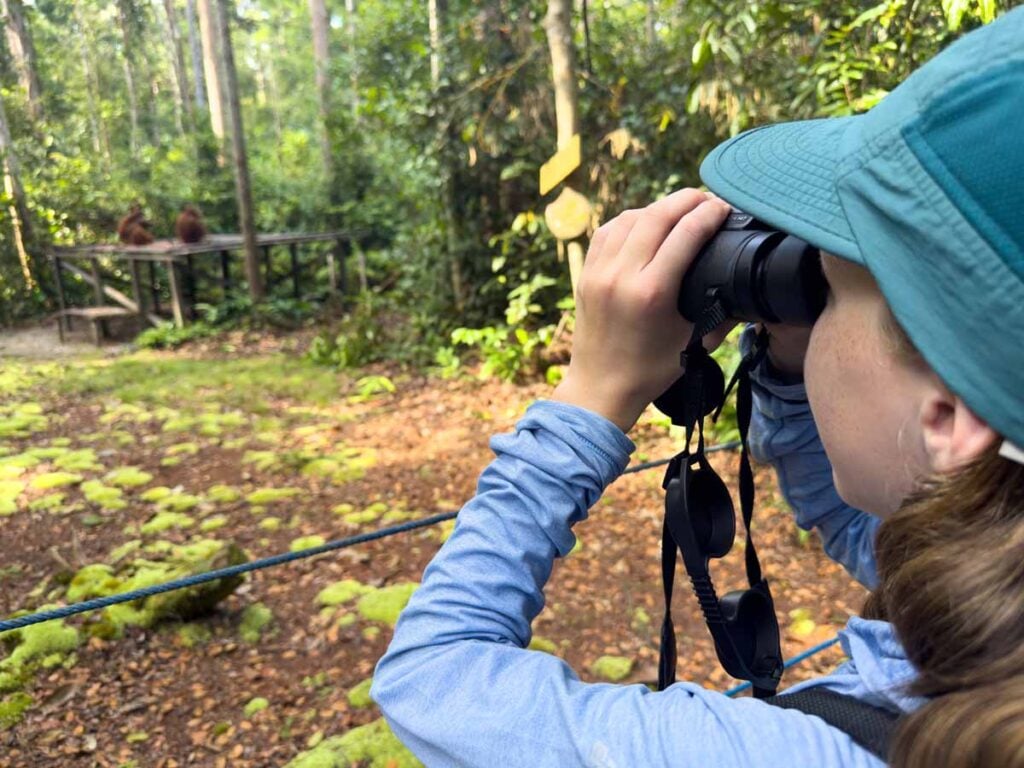
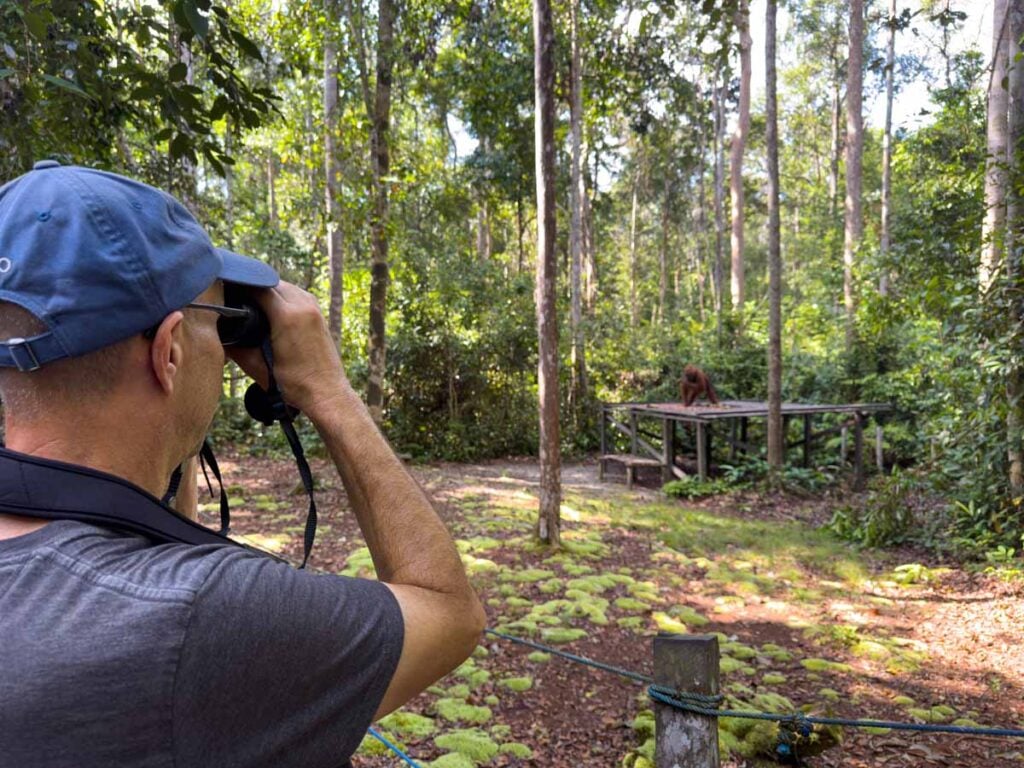
We brought a pair of Nikon Monarch M7 8×42 binoculars to Borneo. They were incredible! I couldn’t have been happier with how crisp and clear the orangutans looked through them!
Day 2: Camp Leakey and a Night Jungle Walk
On our first full day in Borneo with kids, the morning began with a beautiful misty sunrise over the river. A good omen for the rest of the day.
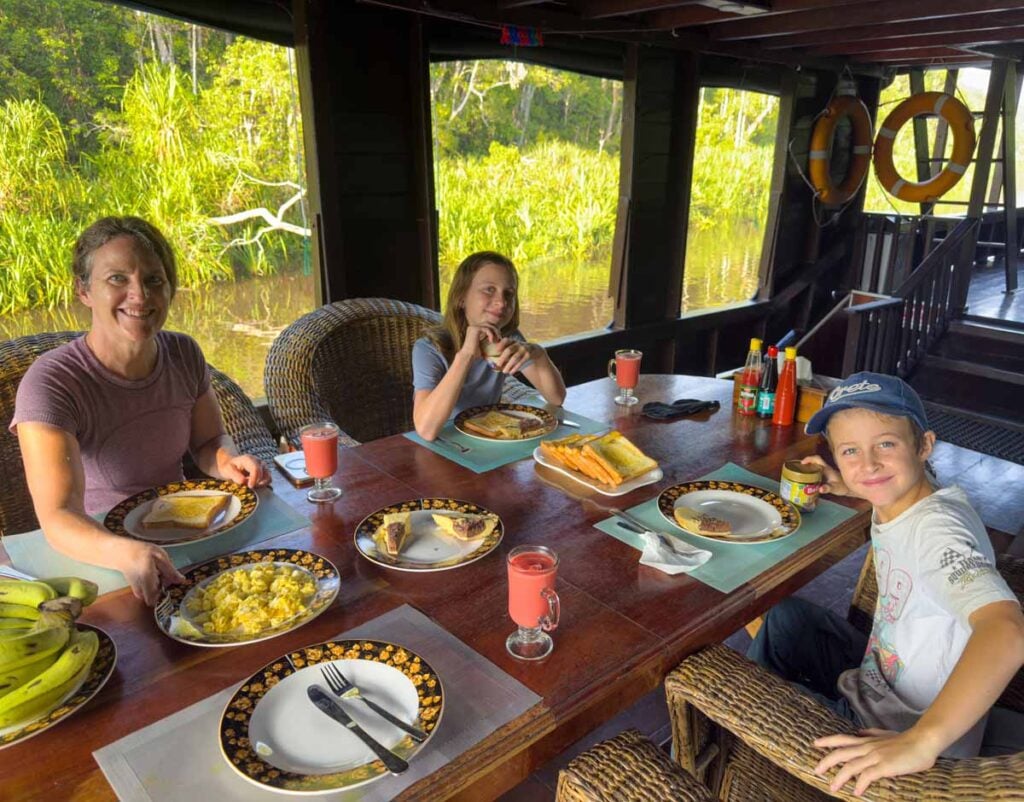
After breakfast, we set off to explore deeper into Tanjung Puting National Park along the Sekonyer River. As we were eating breakfast, we were passed by several other klotok boats. These were on shorter tours and were racing ahead to try and visit two feeding stations in one day.
Klotok Riverboat Safari
Our 5-day Borneo klotok cruise allowed us to take our time. We travelled slowly along the river, watching for wildlife and soaking in the scenery
The slower pace paid off quickly as we spotted a large group of proboscis monkeys in the trees near shore. This was a group of several mothers with their little babies. It’s so fun to watch the little babies playing on the trees, learning how to be monkeys.
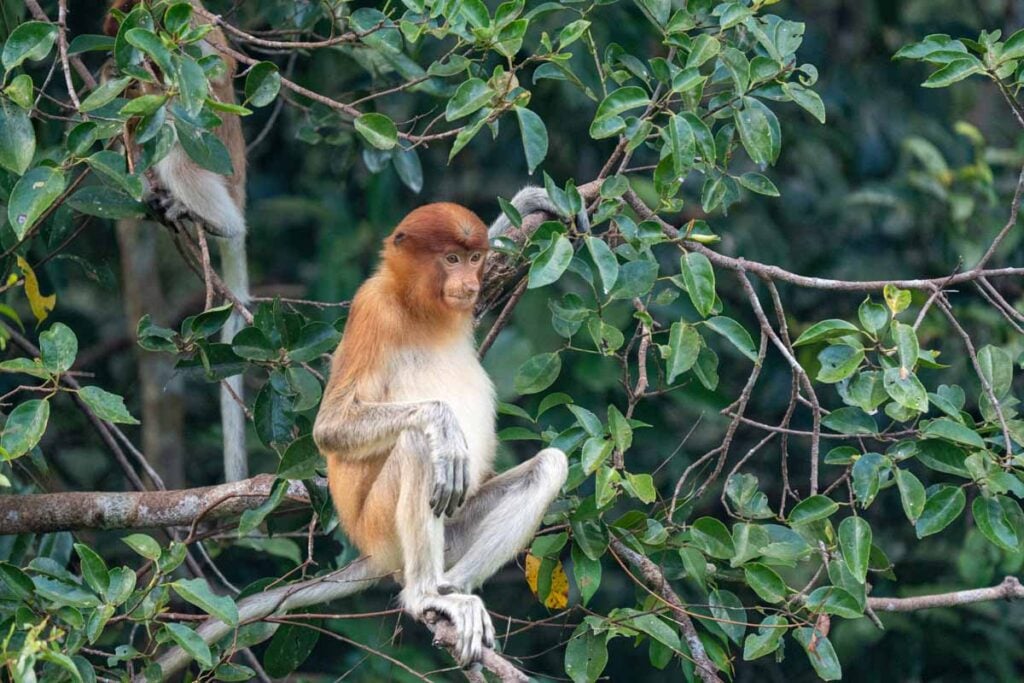
The remainder of our 3-hour journey was just as successful. We saw several other proboscis monkeys along the way, including a few who seemed to be all by themselves. One little guy was sitting in the reeds by shore.
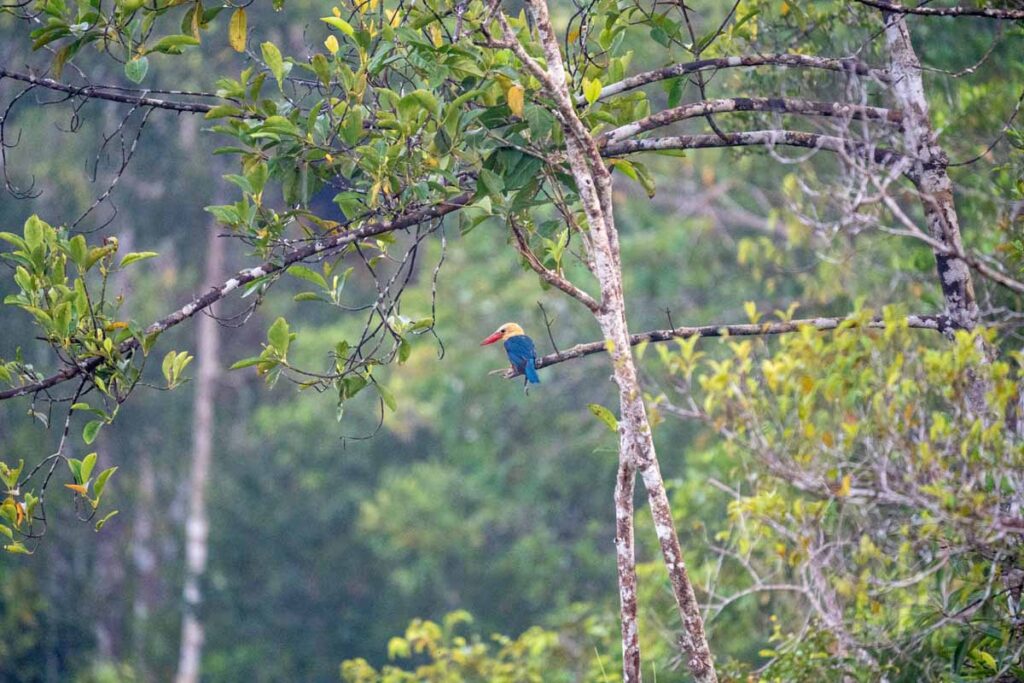
One species we were hoping to see in Borneo was the stork-billed kingfisher. We love spotting kingfishers on our travels and this was likely the most exciting species yet. The stork-billed kingfisher is one of the largest kingfisher species, with a striking red bill and colourful plumage.
We saw seven of these beautiful birds on our way to Camp Leakey but they always flew off before we could grab our cameras. We were determined to get a picture before our Borneo family adventure was done!
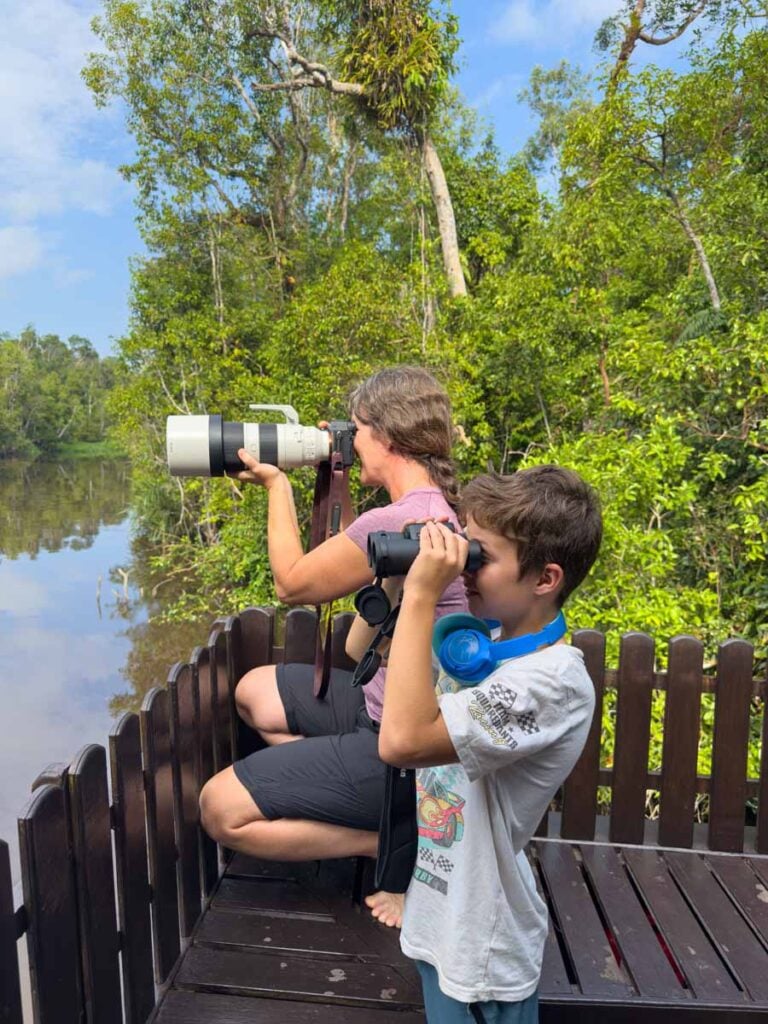
It was fun just watching the jungle go by. There were countless blue butterflies and dragonflies flying near and through our boat. We also noticed a small stick bug had flown into our boat and was sitting on one of our bean bag chairs!
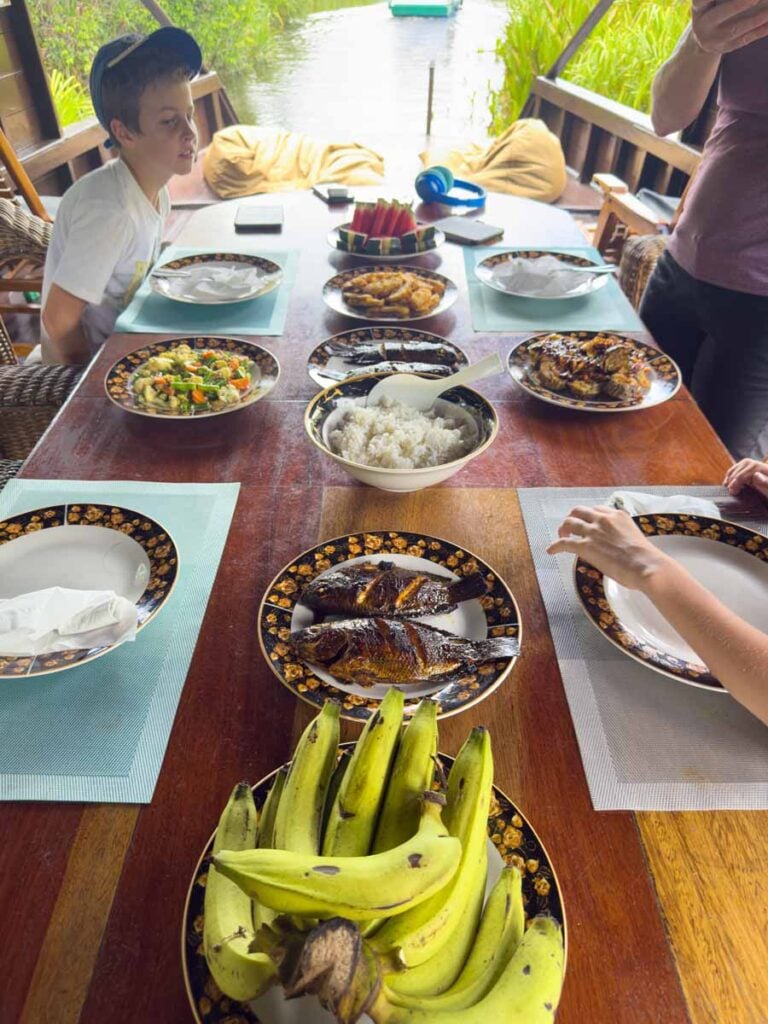
We arrived at Camp Leaky at 11:30 am. I’m so glad we had the time to enjoy a leisurely ride there. Once here, we enjoyed a delicious lunch featuring whole fresh fish.
Read More
We’ve been lucky enough to enjoy some incredible jungle adventures with our kids. Another favourite was our family adventure in Manu National Park, Peru, where we spent our days exploring the Amazon rainforest and looking for wildlife.
Camp Leakey Feeding Station
Camp Leakey was founded in 1971 by primatologist Dr. Biruté Galdikas and has played an important role in the long-term study, rehabilitation and conservation of Borneo’s orangutans. Decades of research here have helped scientists better understand orangutan behaviour and protect their rainforest habitat, making Camp Leakey much more than just another feeding station in Tanjung Puting National Park.
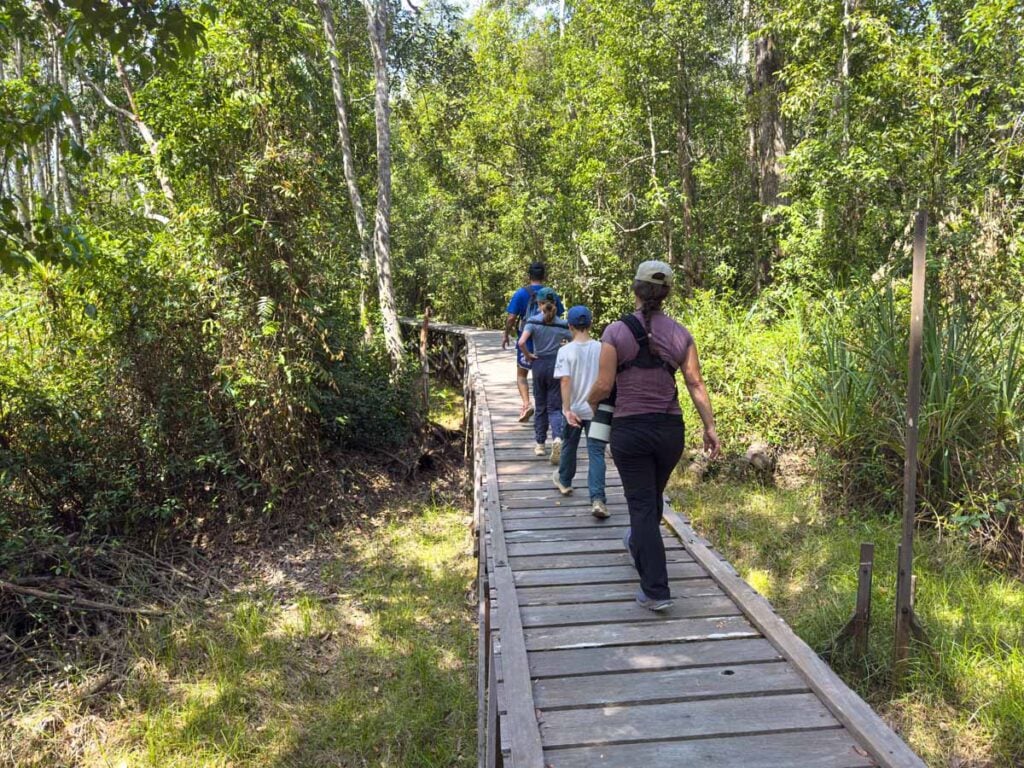
We left our boat at 1 pm and began our walk to Camp Leakey, along an elevated wooden boardwalk, about 5 feet above the jungle floor. The jungle here was thinner and felt more like a forest with round leafy trees.
An Unexpected Orangutan Encounter
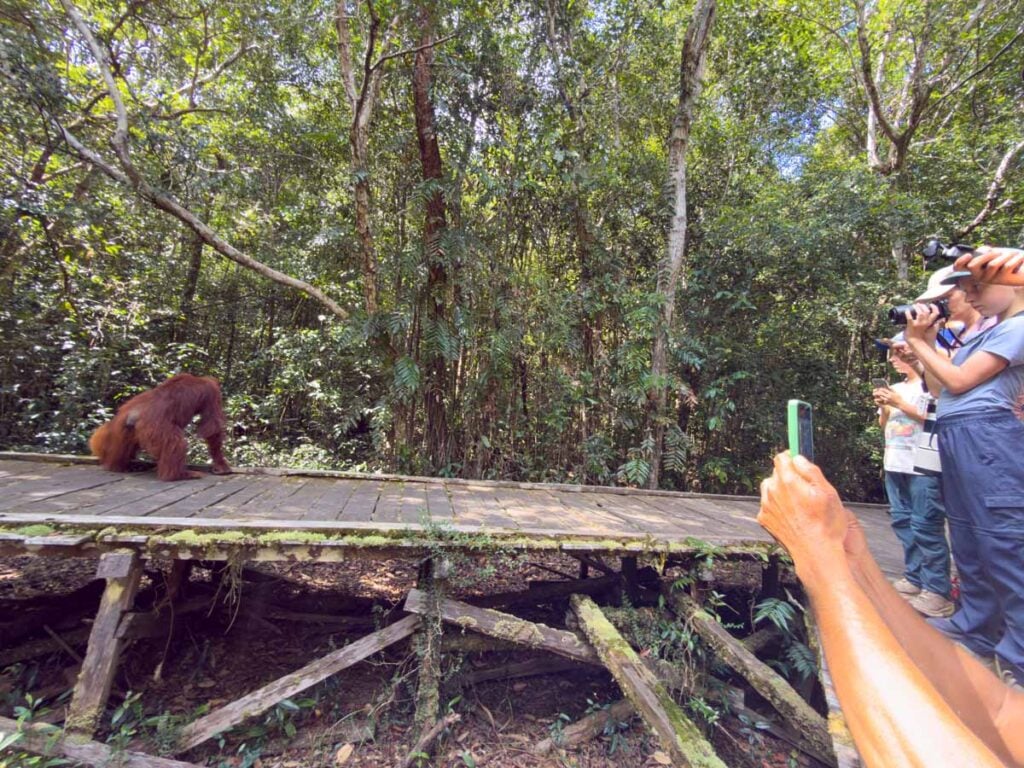
After a while, the elevated wooden boardwalk reached a T-intersection. We needed to go right, but we spotted a mother orangutan and her baby on the boardwalk about 200 m (650 feet) away. While most groups stopped briefly before moving on, we stayed and watched them for about 40 minutes.
When we are lucky enough for a good animal encounter, we never leave expecting to go find something better later. You just never know with wildlife.
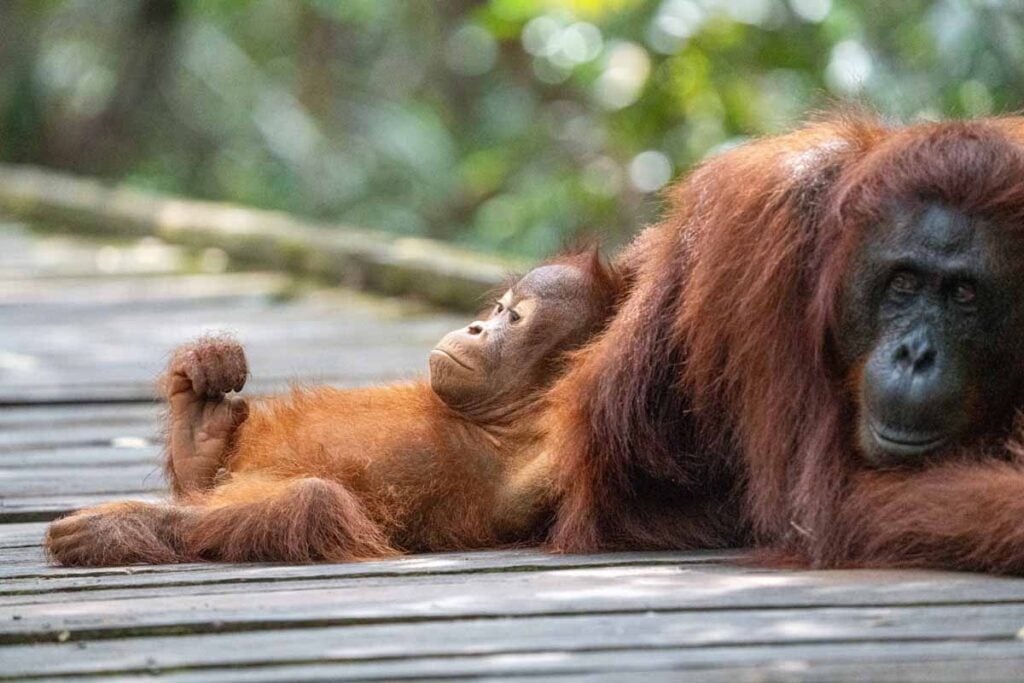
Staying to watch them for a long time turned out to be a good strategy. The baby was crawling all over its mother, playing and having fun. It was incredibly cute to watch.
Slowly, but surely, they started making their way towards us, to the point that we all needed to back up to give them space. They eventually passed over the T-intersection and climbed into a tree and disappeared into the forest.
Camp Leakey Feeding Station Experience
The Camp Leakey feed station was not as successful as our first day. After the food was placed, it took about 20 minutes for the first orangutan to arrive. She appeared in the forest behind us, meaning we were standing between her and the feeding platform.
It was pretty exciting to see her swing through the trees above us in her way to the food. We usually lose interest when they are in the platform eating, but this one was pretty funny. She basically picked up as many corn cobs as she could carry, then she walked off the platform, never to be seen again.
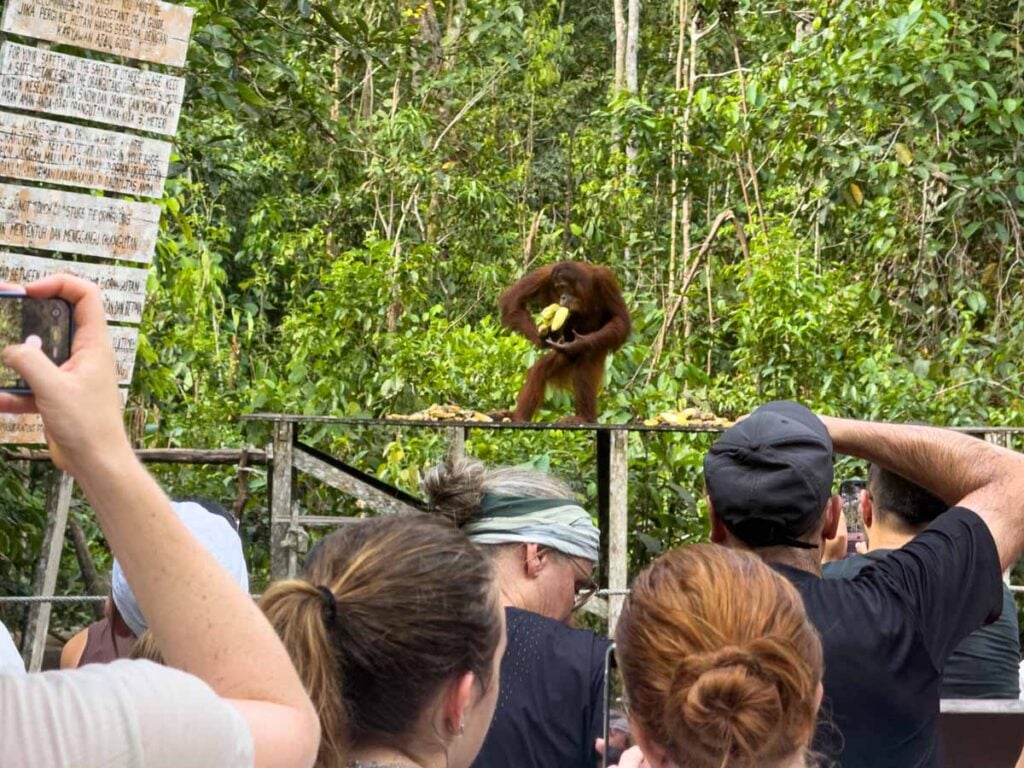
It turned out that she was the only orangutan to visit the Camp Leakey feeding station that day. Our guide explained that there was plenty of fruit growing naturally in the forest, so fewer orangutans had been visiting the feeding station. That was good news, even if it meant fewer sightings for us.
On our way back to the boat we passed the mom orangutan and her baby again. They were very close to the trail, so we continued on to give them the space they deserve.
Another Large Male Orangutan
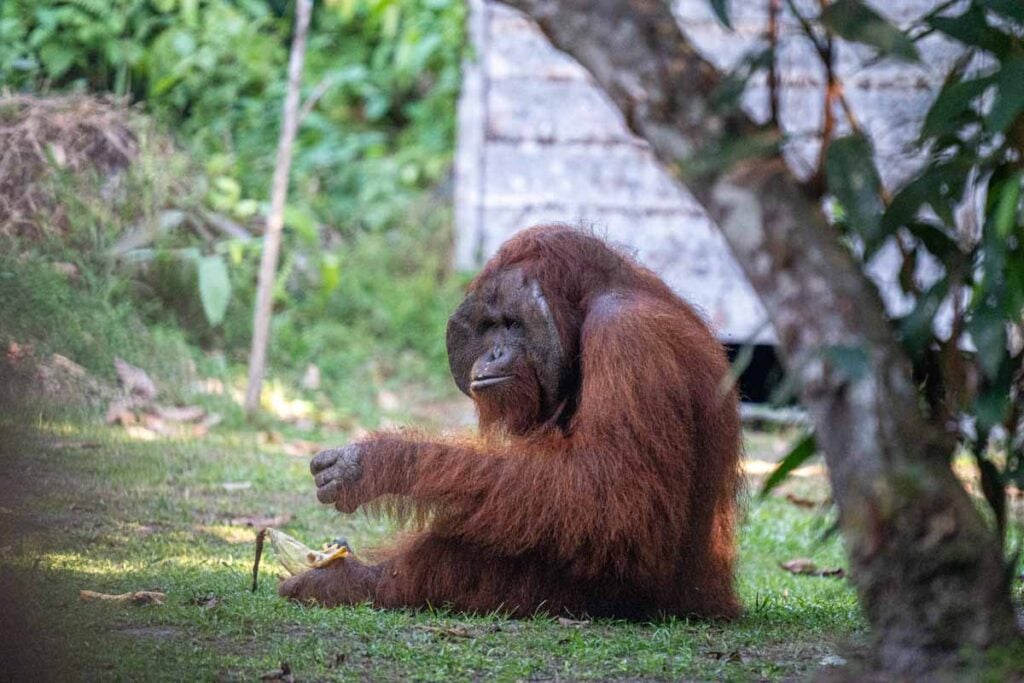
Finally, we saw a large male orangutan sitting on the ground in front of the national park staff accommodations. He had a big pile of corn cobs in front of him, so he was content to sit and eat. It’s always exciting to see a large male orangutan with his face mask, but it wasn’t the best setting for the encounter.
Flying Foxes at Dusk
After Camp Leakey, our captain made his way to a nearby dock for the night walk in the jungle. We moored here for a while to relax waiting for dinner. We entertained ourselves by watching a group of proboscis monkeys in a tree not far from us. This group had a male with a prominent nose and a tiny baby.
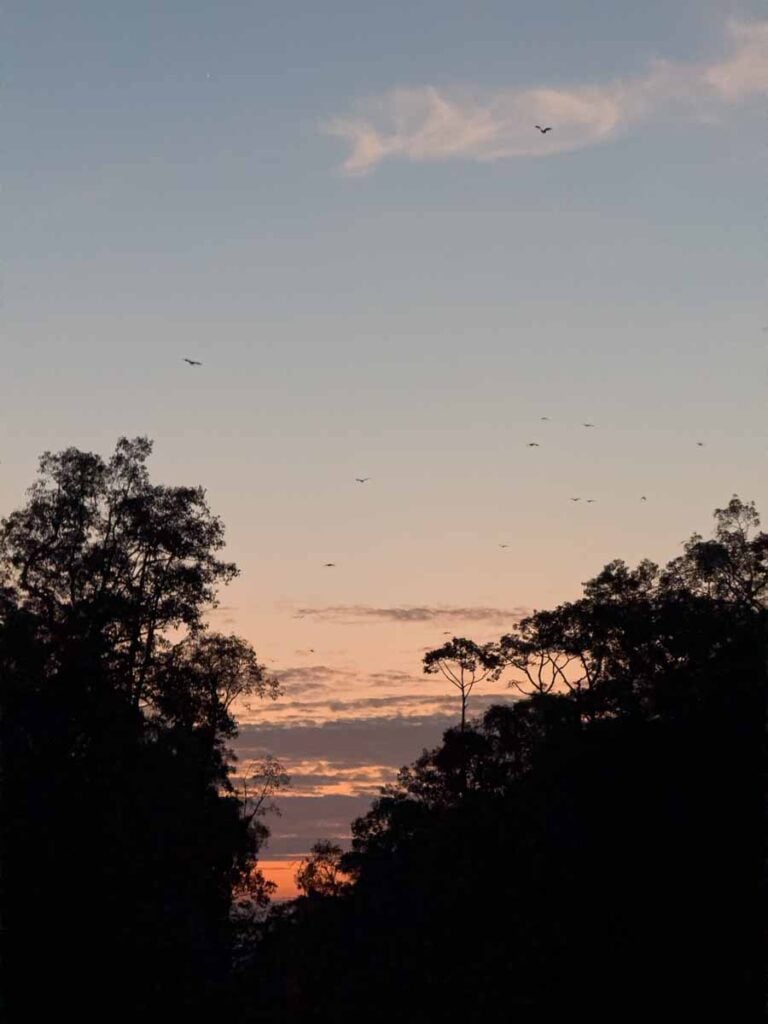
As it was getting dark, my daughter and I were on the roof of the houseboat looking at Venus when we noticed a flying fox in the night sky above. Then we noticed more, then even more. The sky was full of flying foxes heading out at dusk for an evening feed. An amazing sight!
Night Jungle Walk
Once the sky had completely darkened, we grabbed our head lamps and headed into the jungle for a guided night walk. We’ve enjoyed many jungle night walks on our family travels, so we were eager to see what the Borneo jungles had to offer.
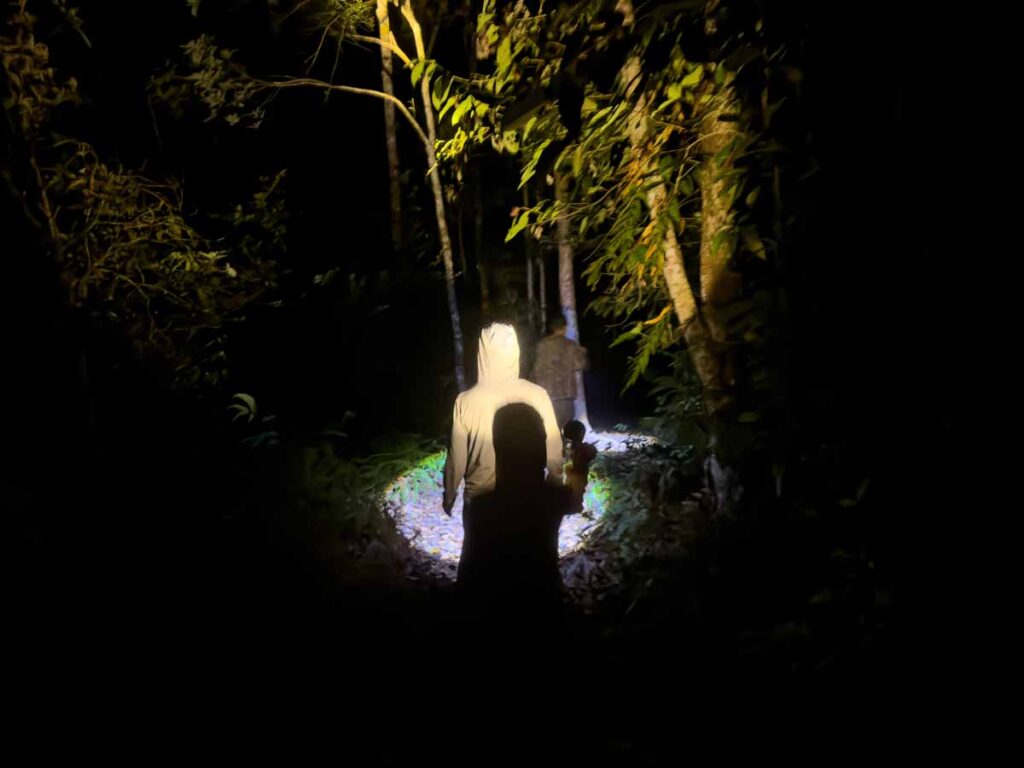
Our first discovery was pretty cool, a leaf cutter ant nest. I love leaf cutter ants, but had never seen a nest before now.
Then we saw the first of three tarantulas. The first was a cute little guy who lived in a hole under a tree root. The second was quite big and hairy (not so cute!), while the third lived on the side of a log near the trail.
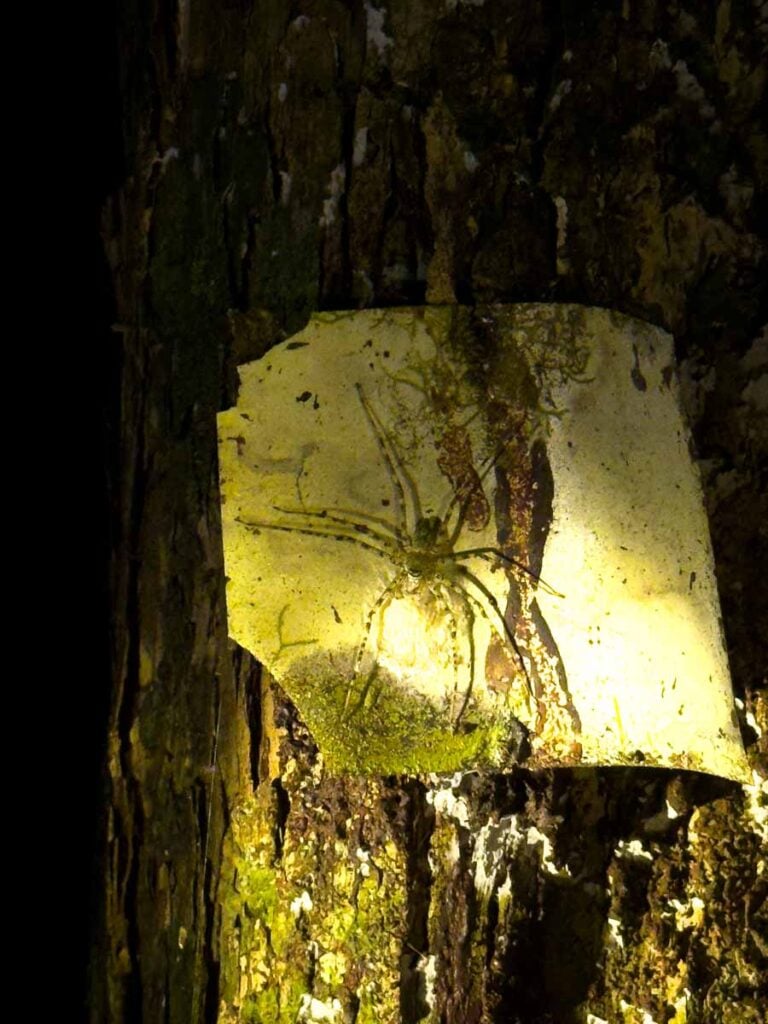
Walking through the jungle at night is always the best way to see creepy, crawly things and Borneo was no exception. The two scariest things we saw were a very large huntsman spider and a very spiky, poisonous centipede with really long legs.
Day 3: Pondok Tanggui and Wildlife Watching
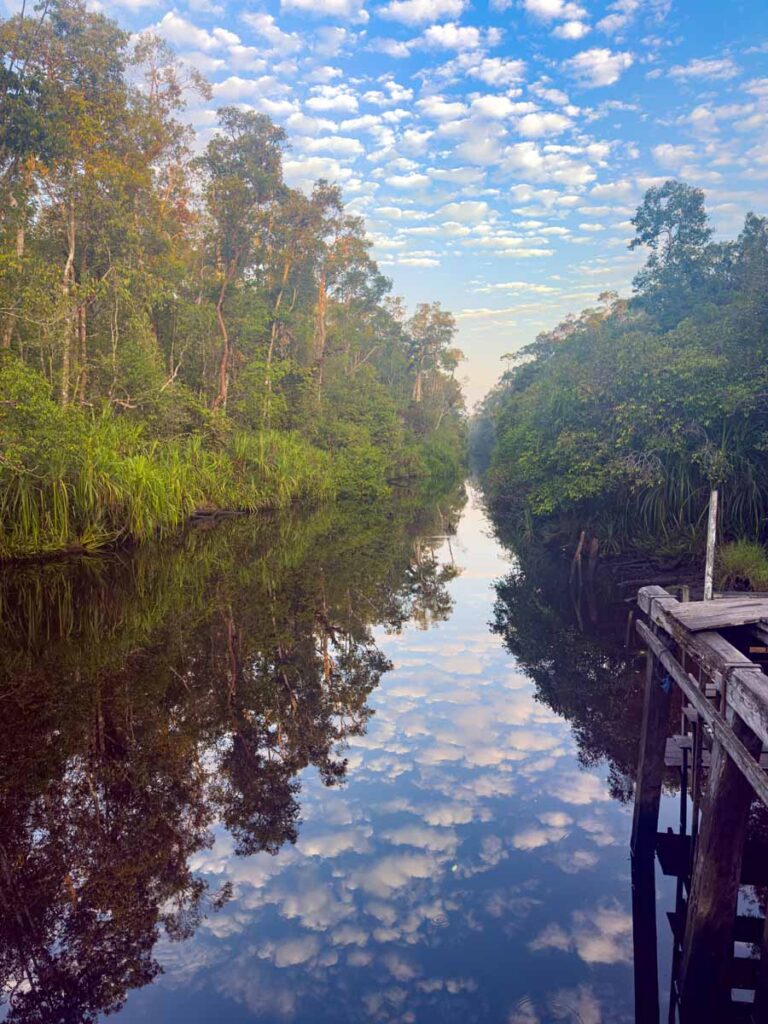
For our third day in Borneo with kids we woke to a beautiful morning on our tranquil stretch of river. The fluffy clouds were reflected in the still water and the sound of birds filled the air. The proboscis monkeys sleeping nearby were gone but there was a beautiful kingfisher on a nearby branch.
After another delicious breakfast, we started our journey towards Pondok Tanggui, the next feeding station. We had another very successful trip in terms of wildlife. We saw several kingfisher birds, a group of macaques, some beautiful small blue birds and a lone proboscis monkey sitting on a tree stump near shore.
Pondok Tanggui Feeding Station
We arrived at the feeding station dock at 8:30 and immediately disembarked. The trail to the feeding station began as another elevated wooden boardwalk, but transitioned to a sandy trail through a deep forest. The highlight of the walk was the large carnivorous pitcher plants growing next to the trail.
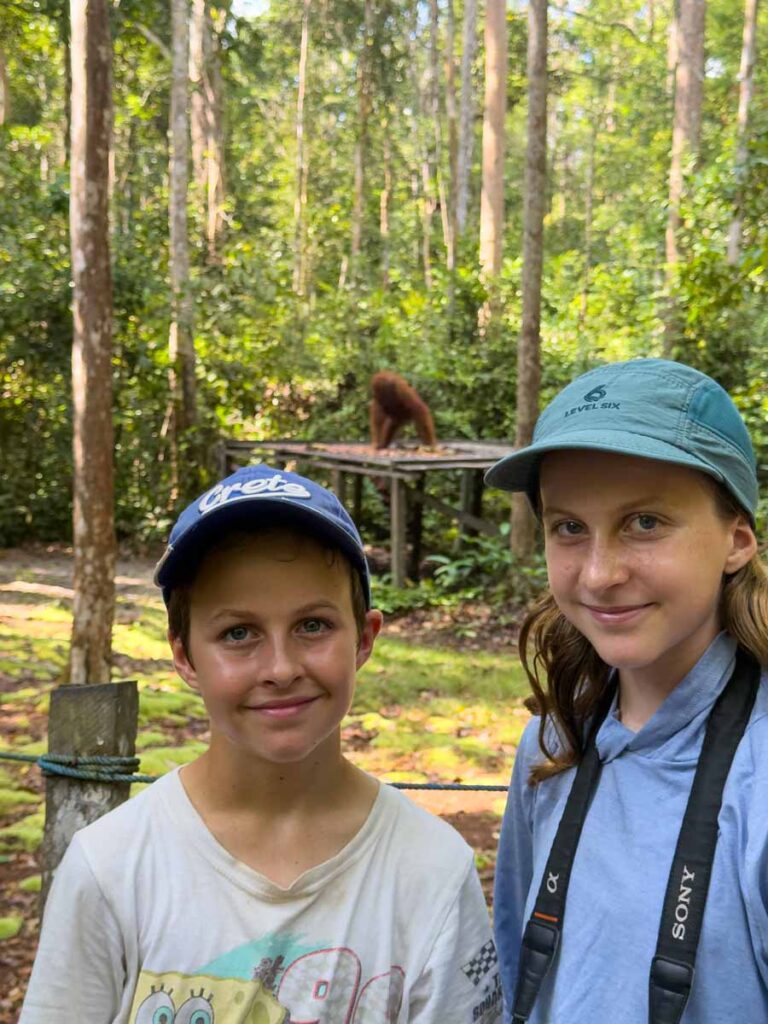
We arrived at the feeding station 10 minutes early to find three orangutans on the platform already: a mom, her older child and a fuzzy little one. These three had their fill of the bananas and sweet potatoes on the platform, while a fourth orangutan waited its turn in a nearby tree.
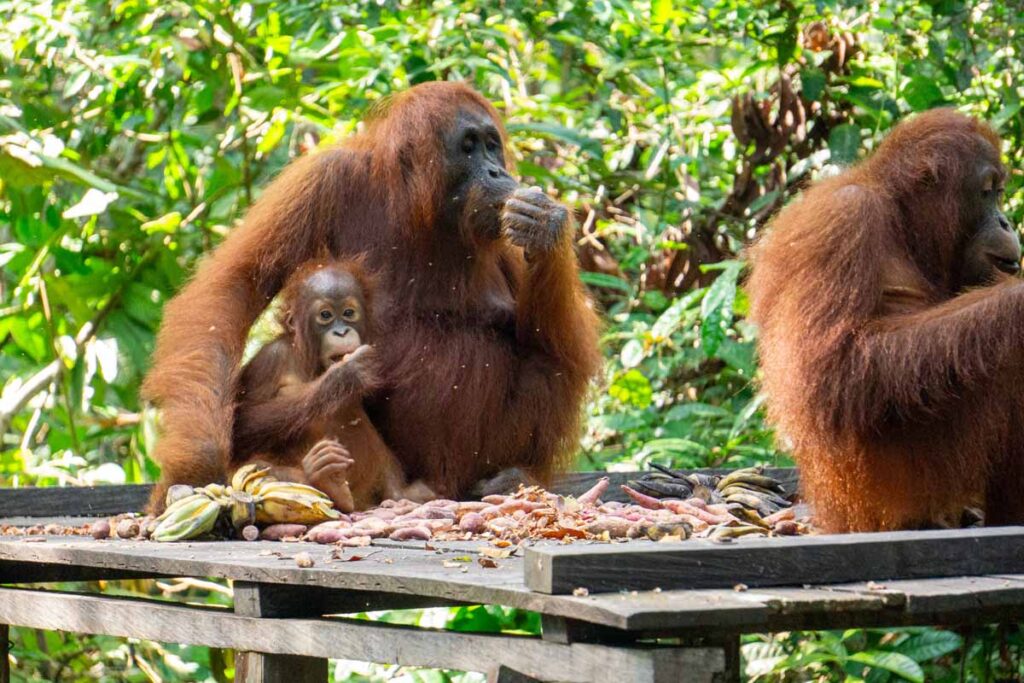
When mom and her two kids left the platform, the fourth orangutan came to get its share. When the rangers came to replenish the food supply, a larger orangutan came to get the good stuff. We suspect it was a non-dominant male, but it was hard to tell for sure.
Macaque Monkeys Arrive at the Feeding Station
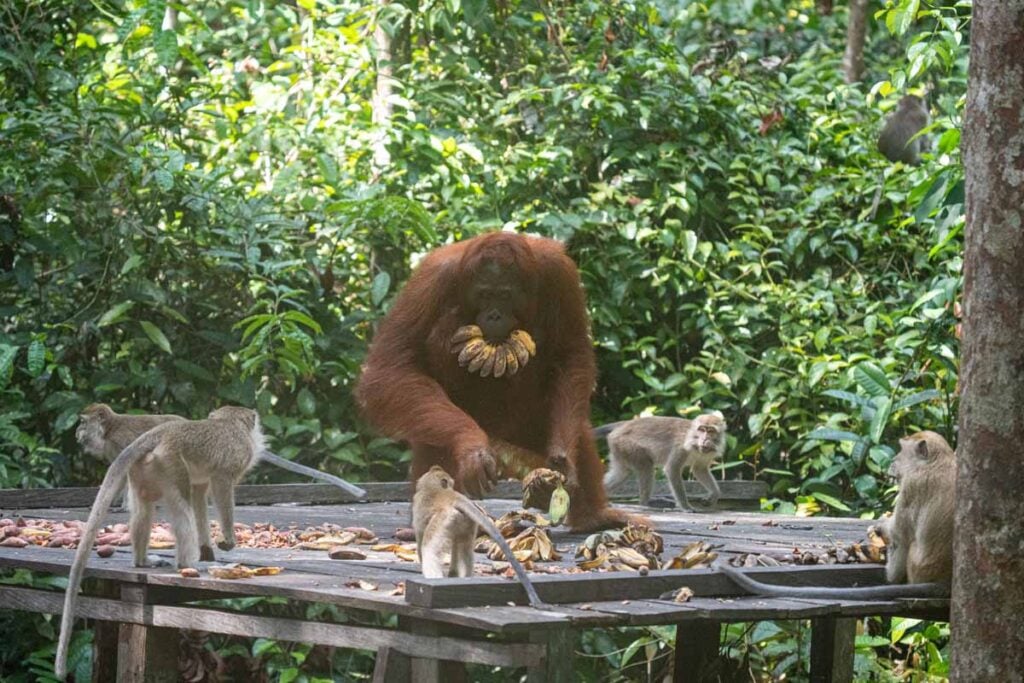
When the orangutans had their fill, the feeding platform was empty for a bit, but then a group of macaques came to feed on the leftovers. This second act of the Borneo jungle show was quite entertaining. To get to the platform, the macaques swung through the trees right above us. There were so many tiny baby ones!
At any given time there were 5-15 macaque monkeys on the platform. It was a lot of fun watching the pecking order in action. The larger males claimed the good stuff, while the smaller ones watched and waited for a turn to snag something good. The babies had to wait quite a while to get their share, often using sneaky or creative tactics to get near.
Two times during the macaque feeding, the mama orangutan returned to grab a bunch of bananas. It was amazing to see her exert her superiority over the much smaller macaques. She even swatted a group of them away at once with a big bunch of bananas!
Even More Wildlife
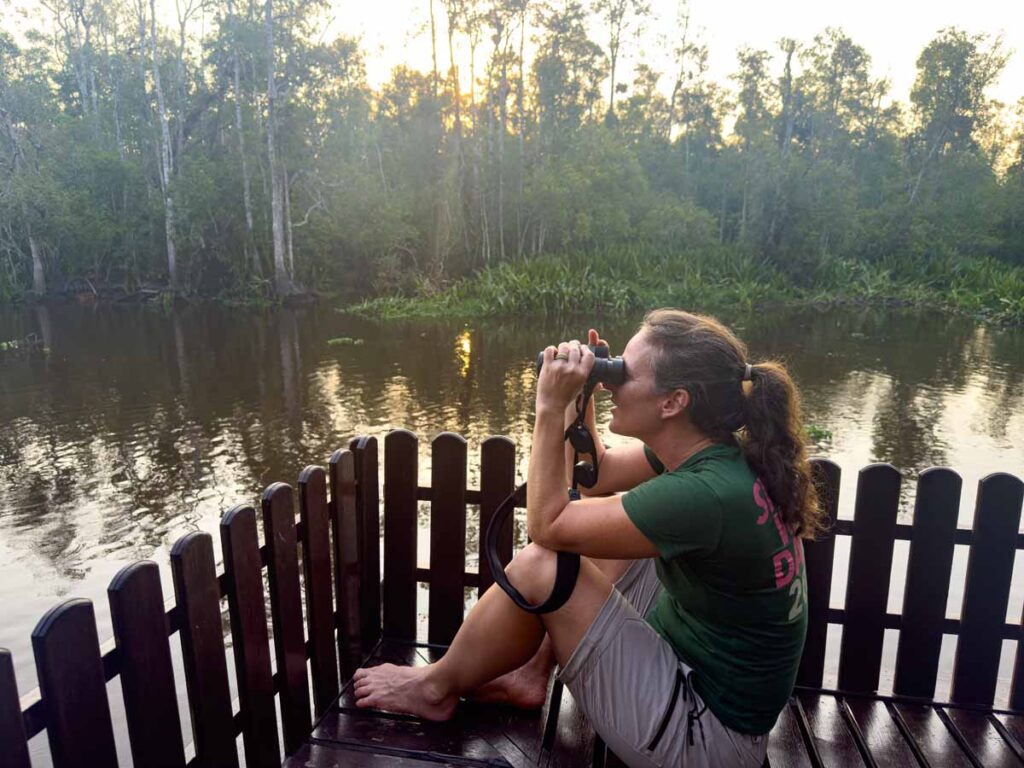
After the feeding station, we slowly made our way back to the night walk platform as we needed to refill our shower water tank. We were having a contest to see who could spot a kingfisher first when Celine spotted one.
I looked where she was pointing, but all I could see was a large proboscis monkey. I thought she was crazy until the kingfisher flew right past it! There is so much wildlife here in Tanjung Puting National Park; we are so glad we decided to visit Borneo with kids!
Daytime Jungle Walk
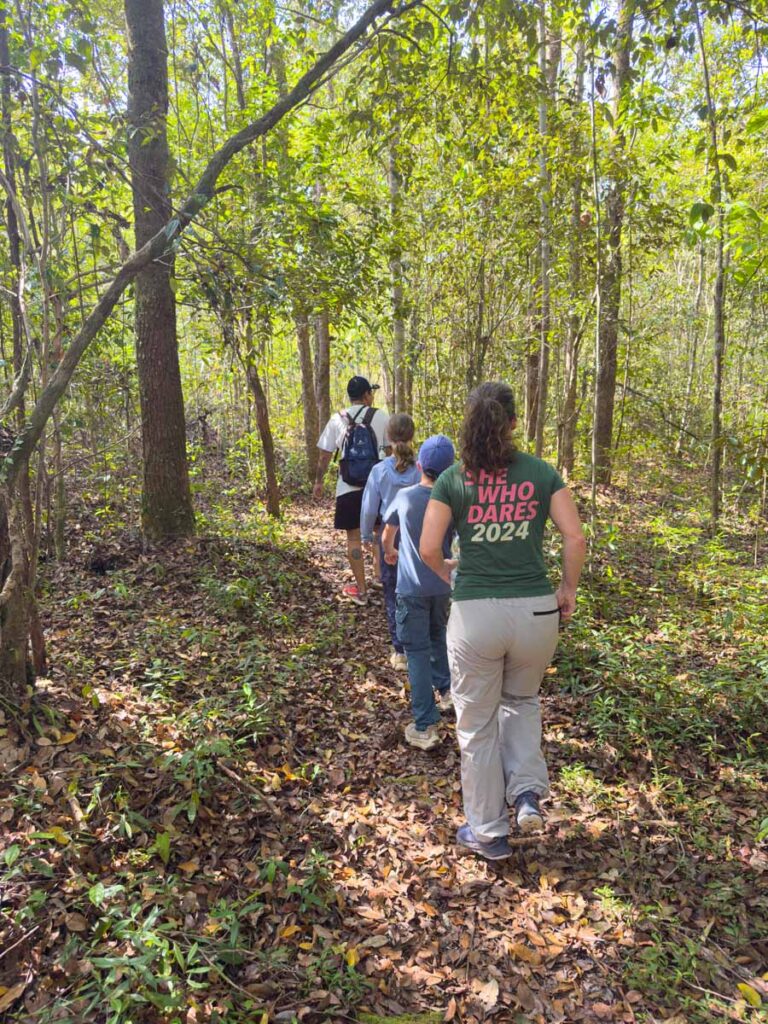
We had some downtime as we waited for the shower water to refill, so our guide took us for a daytime jungle walk. It was along the same trail that we walked during our night walk the previous night, and it was very interesting to see the difference.
There’s a reason that most jungle walks are at night. All the jungle critters come to life at night and are therefore much easier to spot. During the daytime, the jungle critters are all sleeping and are much harder to find.
That said, we did follow a huge butterfly for a while. Then we saw a few proboscis monkeys swinging on nearby trees. And somehow our guide was able to spot a stick bug on the side of a tree. Its camouflage is incredible!
Swimming Proboscis Monkeys
Incredibly, as we were getting ready to depart on our klotok boat we heard a big splash in the distance. It turns out a group of proboscis monkeys were jumping from tall trees into the river to get to the other side! What a treat to see this rare sight. A little known fact is that proboscis monkeys have webbed feet and are decent swimmers.
An Elusive Stork-Billed Kingfisher
We had an exciting moment at the spot where we docked our klotok for the night. We had our binoculars handy as we were watching a nearby group of proboscis monkeys. I heard a loud bird call and I thought to myself, “I want to see if I can find that bird”.
I raised my binoculars and started searching for the bird. Less than a minute later, I found it: a stork-billed kingfisher! Getting a picture of a kingfisher was our goal for the day and in the fading light of the day we got it!
Day 4: Wild Orangutans and Tanjung Harapan
We woke early again to the sounds of the jungle. The jungle is so beautiful in the early morning light. We passed the time looking for birds and had some great success. Many of the fishing-type birds were out, including Striated herons, Blue eared kingfishers and stork-billed kingfishers.
More Wild Orangutans
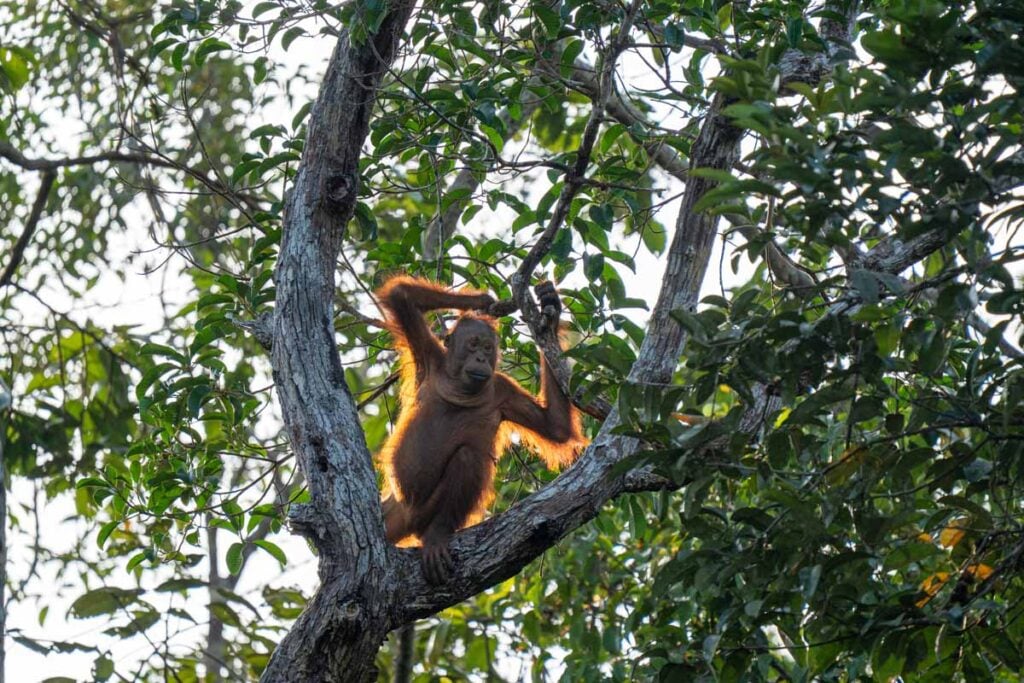
After breakfast we set off down the river. Within 15 minutes we stopped as there were a pair of wild orangutans in the trees. This is our fourth day here and is only the second sighting of true wild orangutans.
This time it was a mom and her 3-4 year old. At this time in the morning their orange fur was glowing a fiery red in the sun. Mom made herself a nest in the trees and had a little relaxation time while the young orangutan sat in a branch eating things off the tree.
We were able to stay and watch the wild orangutans for almost 30 minutes, another advantage of taking the longest Borneo river tour we could find.
More Borneo Wildlife from the Klotok Boat
When we finally tore ourselves away from the wild orangutans, we quickly saw at least ten stork-billed kingfishers, each appearing one after the other.
Our next stop was for a group of proboscis monkeys. There was about five of them, but one was sitting in a palm tree shrub just a few feet offshore. There must have been some young ones just behind in the forest as they were going crazy jumping from tree to tree.
Our next sightings included two macaque monkeys sitting on a beach next to the water. This was followed by a small kingfisher with a red head, and a large monitor lizard swimming across the river.
At 9:30 am we were lucky enough to come across another two wild orangutans. This time it was a mom and her baby orangutan high up in a nearby tree. With our leisurely schedule we spent 20 minutes watching them. The mother orangutan was content to sit in one spot, while her baby was quite playful.
Tanjung Harapan Feeding Station (2nd Visit)
It was with a bit of a heavy heart that we made our way back to the feeding station we visited back on our first day in Borneo with kids. It’s hard to believe that our trip is nearing the end and this would be our final planned orangutan encounter.
Close Encounter with Dominant Male Orangutan
When we neared the Tanjung Harapan Feeding Station we noticed that the dominant male was sitting on a branch about 25 feet above the trail. It was exciting to see the dominant male orangutan sitting in a tree rather than on the feeding platform.
Our guide gave us a hint on where to stand to be close to the male when he decided to make his way to the platform. We were grateful for the hint as we got within a few feet when he passed us on the ground. Exhilarating and a bit terrifying at the same time!
Tanjung Harapan Feeding Station Experience (Visit 2)
The feeding station experience was pretty much the same as our first visit. It was very crowded and there was a lot of jockeying for position for good photos.
The best strategy at the Tanjung Harapan Feeding Station is to hang back and focus on the orangutans that are in the trees nearby. During both of our visits here, there were plenty of orangutans in the surrounding trees. The pictures of these orangutans are way better than those sitting and eating human food on a wooden platform.
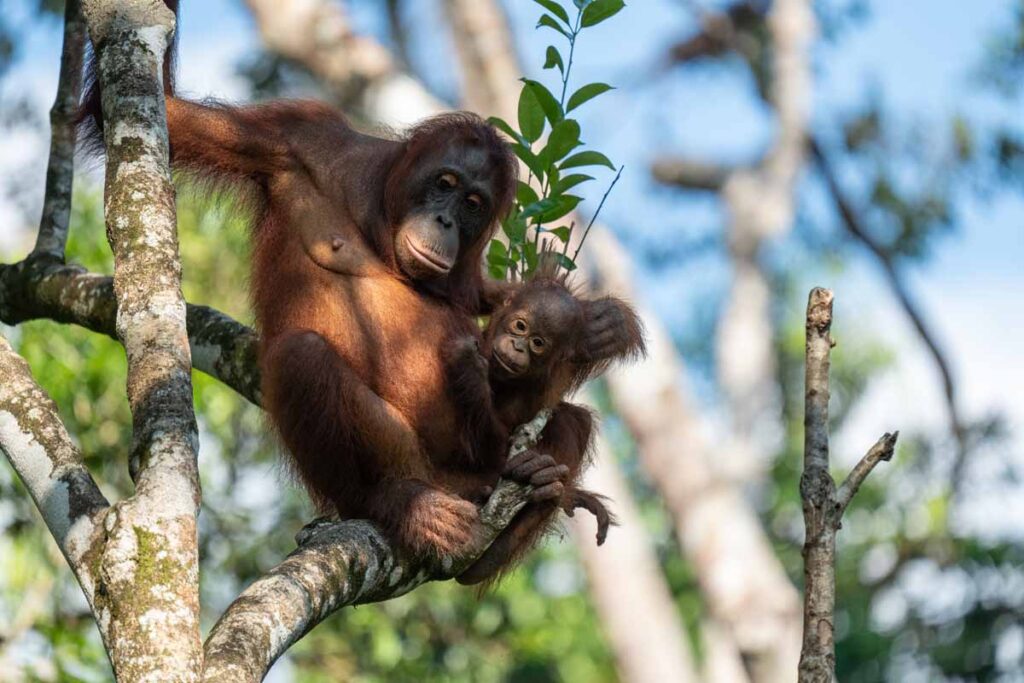
Other highlights from today’s visit included watching three young orangutans who appeared to be without a parent. We guessed they were just old enough to have left their mothers.
There were several mothers there with their little ones as well. The baby orangutans always steal the show. One mother in particular had to grab her baby by the leg to keep it from bothering the dominant male. It was pretty hilarious.
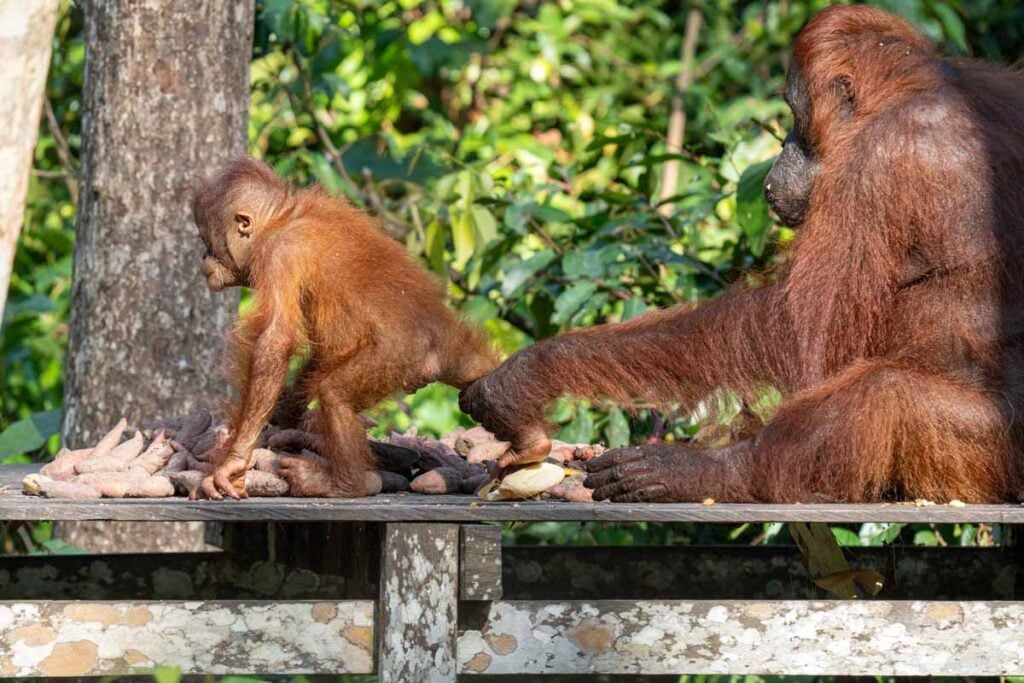
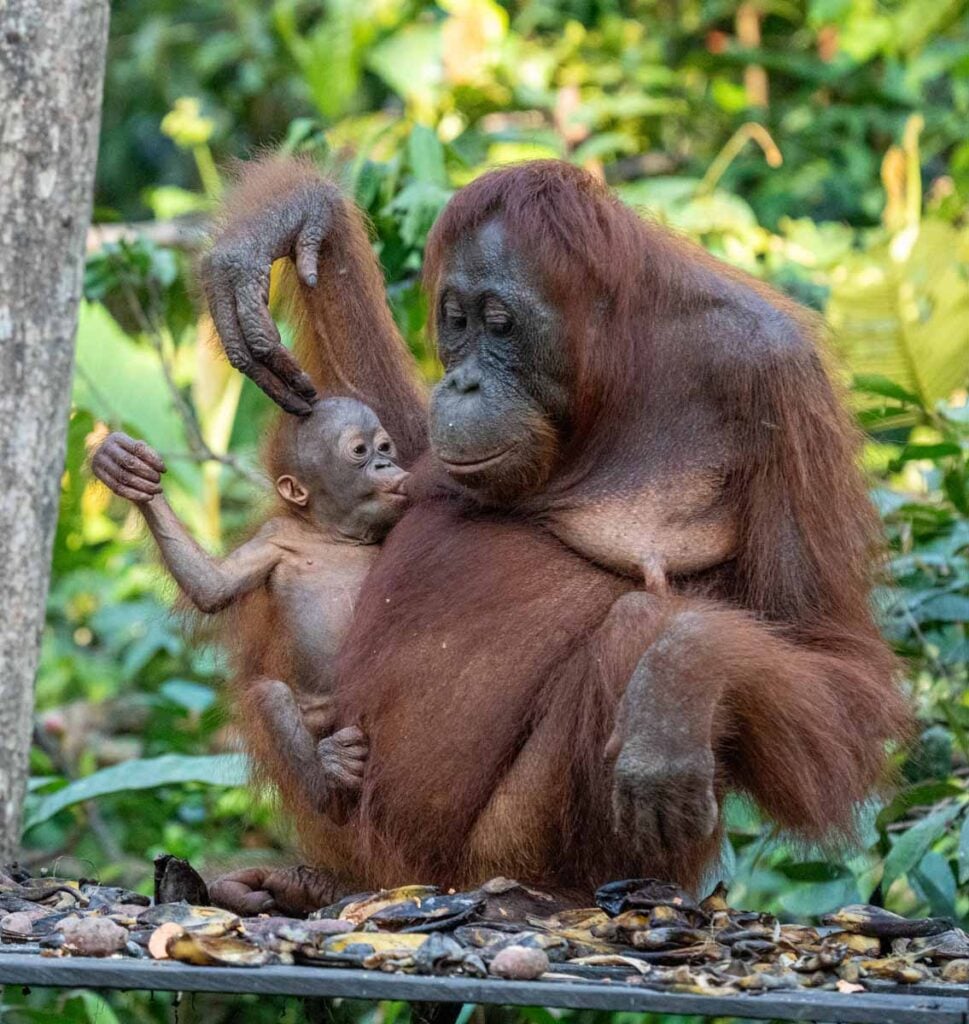
My personal favourite was a mother who brought her tiny baby. This baby orangutan was the youngest we’d seen all week. Our guide guessed he was less than a year old. He was so cute and so full of mischief, I could have watched him all day.
Day 5: Jungle Trekking and River Exploration
As usual, we began our final day in Borneo with kids by waking up at dawn and enjoying the sights and sounds of the jungle as it wakes up. This morning’s highlights included macaque monkeys and a little woodpecker in a small palm tree next to our boat.
Daytime Jungle Trek
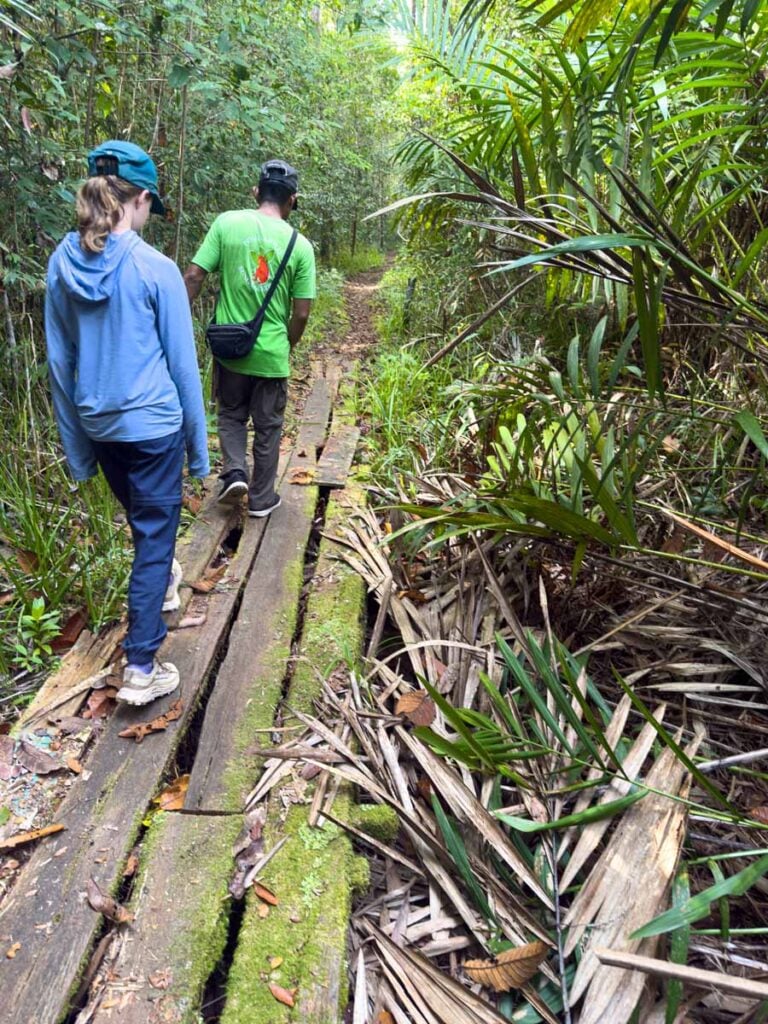
We began our jungle trek at 7:50 am at the dock of Tanjung Harapan Feeding Station. This time we were led by an official national park guide.
As is typical, the jungle is not as active during the day, but starting our hike early in the morning meant cooler temperatures. We began through a deciduous forest alive with butterflies and the sound of cicadas.
We soon passed a group of macaque monkeys, then saw a large stick bug flying through the air, which is easily identified by its red coloured wings.
We saw a few signs of recent orangutan activity including fresh poop on the trail and half eaten fruit pieces. It was exciting to see, but the chances of seeing a wild orangutan while hiking on foot are so small.
Our guide showed us an “iron tree” known for its incredibly strong wood. There was a little hole in its side for a stingless bee nest. This gave us a unique opportunity to put our ear to the hole and listen to the bees buzzing inside.
We passed several large tarantula holes, but were unable to coax one to come out. We also saw a cute little fruit bat hanging upside down in a shelter.
Read More
We love exploring new places on foot, and hiking through the Borneo jungle was a completely different experience from many of our other adventures. If your family enjoys hiking too, check out our favourite family hiking vacations around the world.
Longboat Tour Down a Tranquil River
After our 8 km (5-mile) jungle hike, we climbed into small longboats, with two people in each. Our guides paddled us slowly down the peaceful river. Surrounded by jungle, it was one of those moments I won’t soon forget.
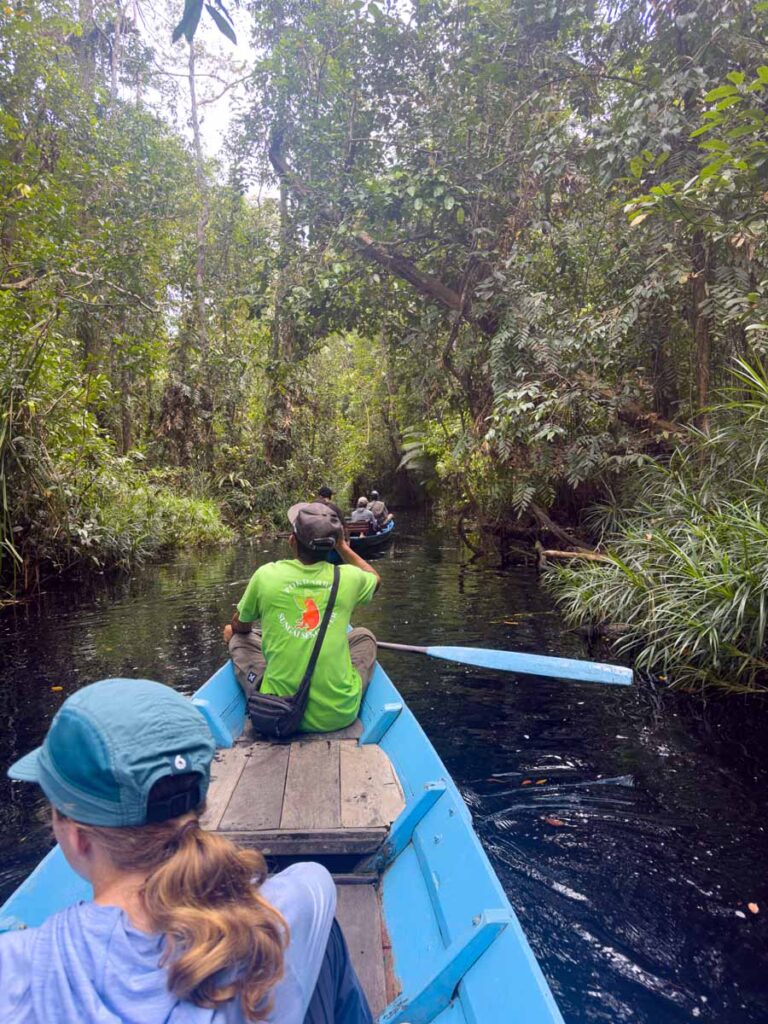
I soon saw a tiny frog clinging to a leaf, just inches above the water. This was followed by a group of active proboscis monkeys in the nearby trees.
Our guide pointed out a tiny yellow snake sitting on a stump over the water. Our daughter noticed a second snake of the same species nearby.
A stork-billed kingfisher flew across the water in front of us as we approached more proboscis monkeys. This time we saw one of them take a giant leap across the water.
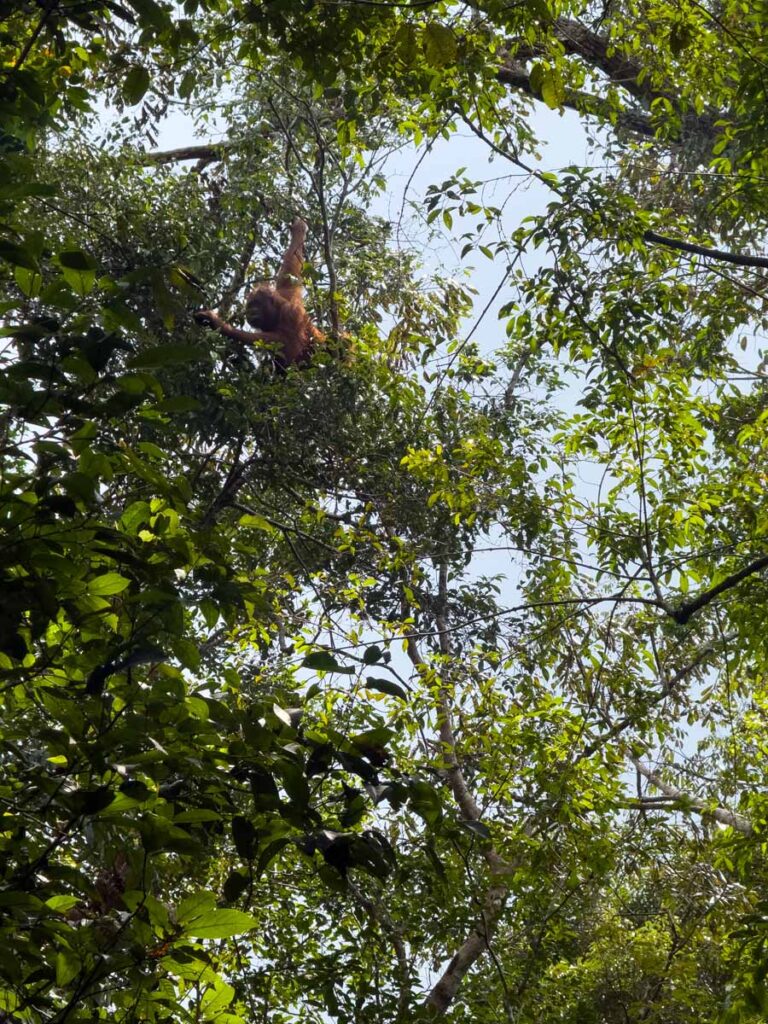
Then, incredibly we saw even more wild orangutans! A mother and her baby were high up in the trees not far from the shore. I thought I had said goodbye to the orangutans yesterday, so this was a massive thrill to see two more wild ones!
Village Walk through Sungai Sekonyer
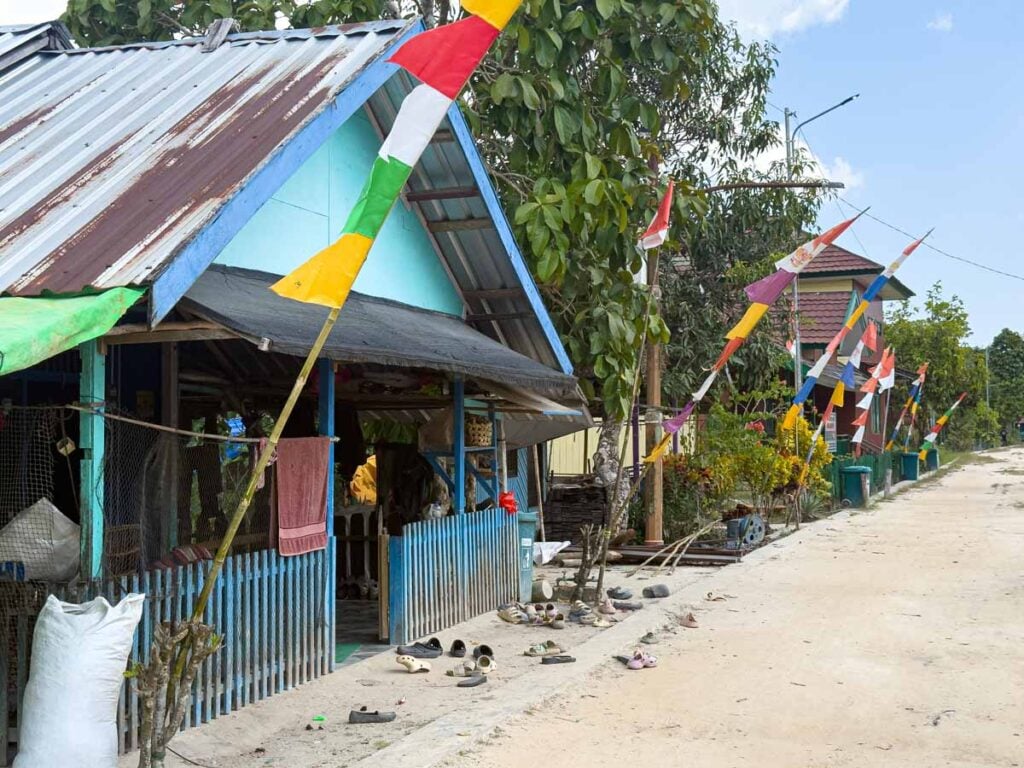
After lunch we went for a quick walk through Sungai Sekonyer, the village near the park. Many of the residents here work in Tanjung Puting National Park, while others work for nearby palm oil plantations.
Sungai Sekonyer is a small but interesting village, with one main street and a canal running alongside it. Local kids were playing in the water, giggling and having fun. The houses were quite colourful, with many locals sitting outside with a friendly wave and a smile.
Tanjung Harapan Feeding Station Experience (Bonus Visit)
After our village tour, our guide surprised us by announcing we could go to the Tanjung Harapan Feeding Station one last time! We had already done all of the promised feeding stations on our tour, so we were really happy to have a bonus trip!
This time we took a different approach at the Tanjung Harapan Feeding Station. We found four shady seats in the front row and just sat and enjoyed watching these magnificent creatures one last time. It was a wonderful experience which focused more on enjoying watching them and less on taking pictures.
A Final Gift from Tanjung Puting National Park
Afterwards we got on our klotok boat and began our journey out of Tanjung Puting National Park. The park had one more surprise for us though…
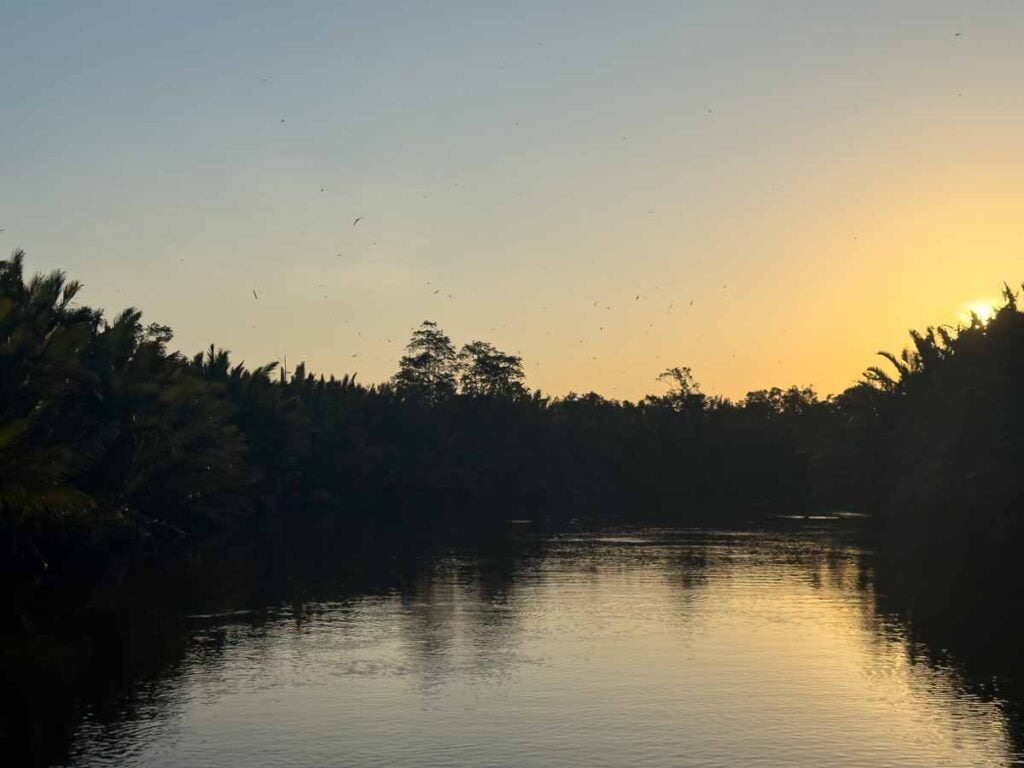
As the sun was starting to set, hundreds, if not thousands, of swallows filled the sky over the water in front of our boat. They were showing off their acrobatic skills, flying every which way, occasionally dipping into the water for a fish.
Recommended Gear for Borneo with Kids
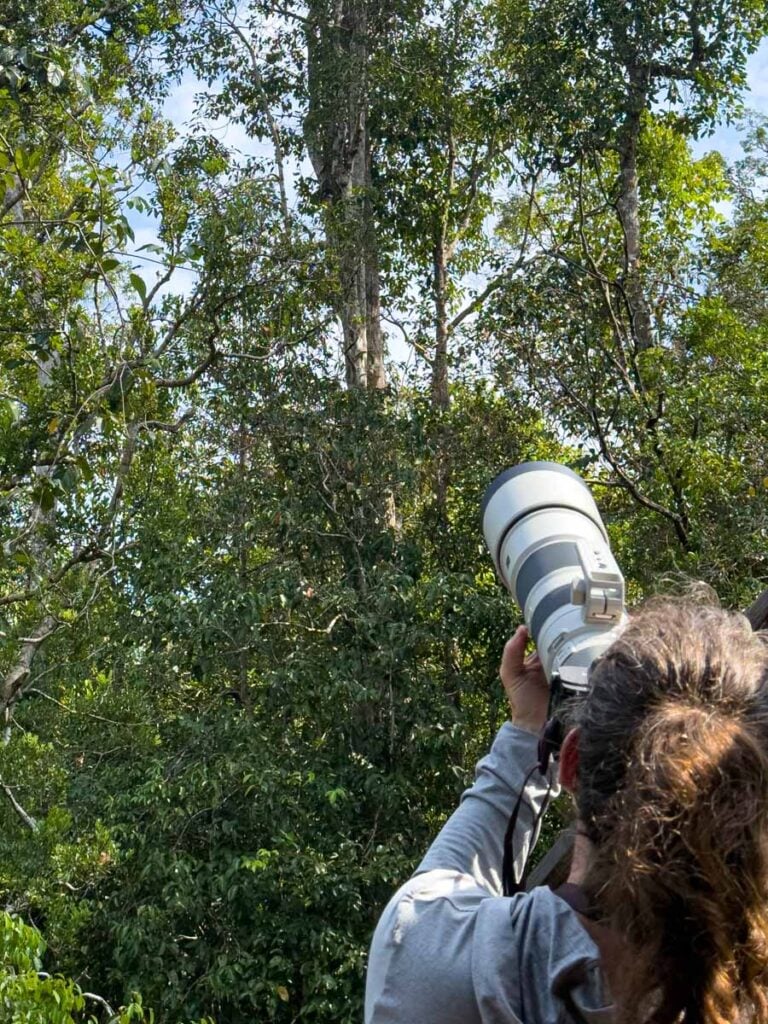
Two summers prior to our family trip to Indonesia, we went on a family trip to Kenya and Tanzania with kids. Given we went on many safaris, we decided to invest in some safari-grade camera equipment. We decided on a Sony Alpha A7IV full-frame mirrorless camera along with a Sony FE 200-600 F5.6-6.3G lens.
We were extremely happy with the quality of photos we got on safari with this powerful camera combination! We brought this same camera set-up on our family trip to Borneo, and you can see for yourself how good the pictures turn out. The orangutans are usually so far away that a phone camera would be completely ineffective.
As mentioned above, a good set of binoculars is a must-have for any family holiday to Borneo. I can’t say enough good things about our Nikon Monarch M7 8×42 binoculars. They are fog and water resistant, which are important in a jungle environment. But most importantly, they were crystal clear and easy to use. I highly recommend these binoculars for orangutan viewing in Borneo.
How to Book a Borneo Orangutan Tour with Kids
Our Experience with Orangutan Trekking Tours
We booked our 6-day, 5-night Borneo tour with Orangutan Trekking Tours, and we would happily recommend them to other families. Our tour was private, which worked extremely well for us travelling with kids, and we loved having five nights to slow down, look for wildlife and really enjoy our time in Tanjung Puting National Park.
Orangutan Trekking Tours also offers shorter 4-day and 5-day trips if you aren’t ready to commit to five nights on a klotok. Their tours include your private boat, guide and crew, meals, national park fees and transfers from Pangkalan Bun, making the logistics surprisingly easy once you arrive in Borneo. They can also adjust the itinerary based on your interests and the wildlife activity during your visit.
See the Borneo tour we booked with Orangutan Trekking Tours
Other Borneo Orangutan Tours for Families
You definitely don’t need to spend five nights on the river to have an incredible orangutan experience in Borneo. If you are travelling with younger kids, have limited vacation time or simply aren’t sure your family is ready for a longer stay on a klotok, there are some excellent shorter tours available from Pangkalan Bun.
Several 3-day, 2-night klotok tours visit Tanjung Harapan, Pondok Tanggui and Camp Leakey, giving families the chance to see all three of the main orangutan feeding stations while spending just two nights on the river. There are also private 4-day tours, which give you a little more time to look for orangutans, proboscis monkeys and other wildlife without committing to the full five nights that we did.
For families, I would strongly consider a private tour if it fits your budget. Having your own klotok gives you more flexibility with kids, and you won’t need to worry about your children disturbing other travellers during the quieter stretches of the trip. Just be sure to look closely at the boat facilities, sleeping arrangements and what is included, as these can vary between operators.
Browse Borneo orangutan and klotok tours on Viator
5 Days in Borneo with Kids: Final Thoughts
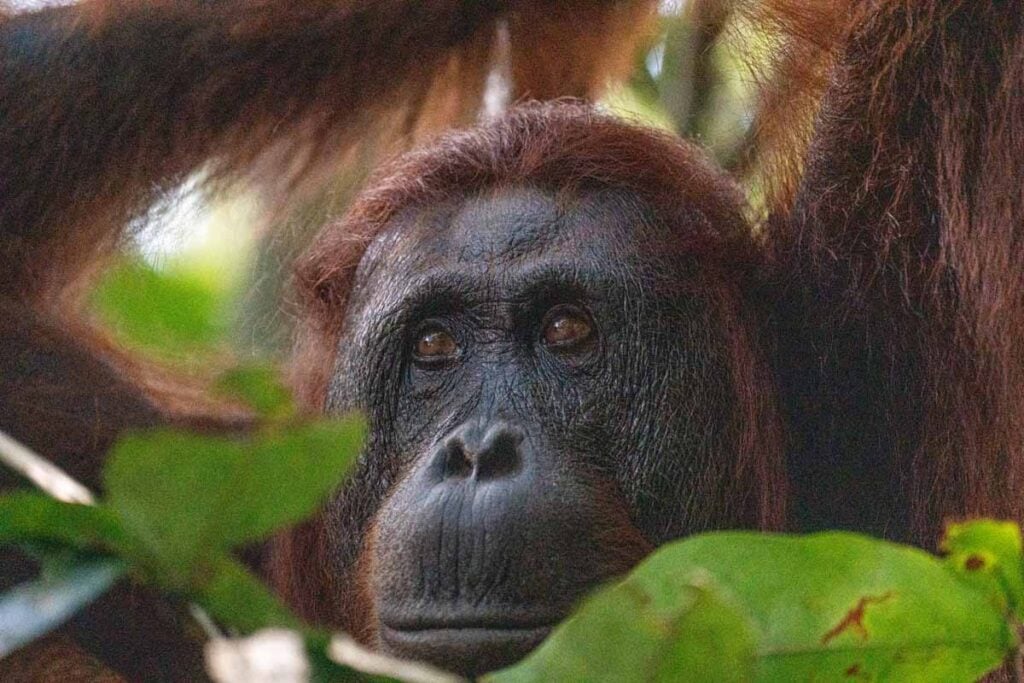
Visiting Borneo to see orangutans has been on my bucket list since I was a little kid. I was a little afraid that I had built up my expectations too high and I would be let down by the real-life experience. Thankfully, we needn’t have worried, as we loved our family trip to Borneo. In fact, our kids think it belongs in our top five family trips of all time!
The entire experience of visiting Borneo with kids was amazing, especially seeing the semi-wild and wild orangutans. But, our moments on the klotok boat were equally special. We especially loved sitting together on the front deck, talking and watching the jungle pass by. We never got tired of looking for wildlife, especially because there always seemed to be something new to discover.
I had dreamed of coming to Borneo my entire life to see orangutans. The real life experience exceeded my expectations. If your family loves wildlife and adventure, I highly recommend you visit Borneo with kids as well.
More of Our Family Adventures in Indonesia
Before visiting Borneo with our kids, we previously spent 10 days in Sumatra and 5 days in Bali.
In Sumatra, we began with an adventurous visit to Bukit Lawang with kids where we enjoyed a wide variety of jungle based activities including an elephant encounter and hiking to see orangutans. From there we spent a few days on the tropical island of Pulau Weh with kids.
During our 5 days in Bali with kids, we enjoyed a ton of family adventures including ATV rides, white-water rafting, jungle hiking, bike tours and of course, some temple visits too.
Our family trip to Borneo marked the end of our 3-week family trip to Indonesia. After Borneo, we flew back to spend a few days in Singapore with kids before heading back home to Canada.
Our Travel Journal for Kids
Based on our family travels, our kids helped us design this Travel Journal for Active Kids! This engaging travel journal encourages kids to document their adventures, spark creativity, and stay entertained on the go – grab yours now on Amazon!
