
Our kids had read several books on Pompeii, so when we told them we wanted to go on a family trip to Italy, they practically begged us to go to Pompeii. After looking into the region and discovering that Pompeii was close to the Amalfi Coast and the beautiful island of Ischia, we decided to visit Pompeii with kids.
The best part is that we were able to piece together several activities that helped tell the full Pompeii story. During our stay we were able to climb to the summit of Mt. Vesuvius, visit Herculaneum (another town impacted by the infamous eruption), and of course, visit the famous Pompeii ruins.
We loved visiting Pompeii with kids. It was educational, memorable and a lot of fun. We would recommend any of these family-friendly Pompeii activities for your family too!
This post contains compensated links.
Hiking to Mt. Vesuvius
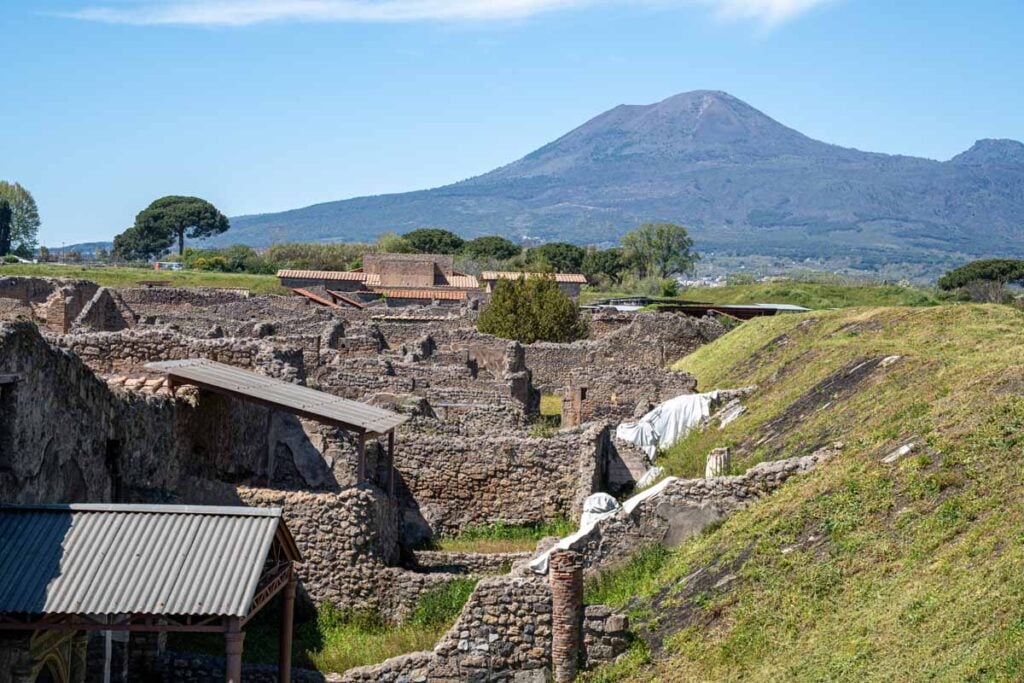
After spending a day in Rome with kids, our first family Pompeii adventure was to climb to the summit of Mount Vesuvius. Towering over the nearby city of Naples, climbing Mount Vesuvius is a popular thing to do with kids. We do a lot of hiking with our kids around the world, but this one felt special as it’s such a famous volcano.
If you don’t already know, Mt. Vesuvius is the volcano whose eruption buried Pompeii and Herculaneum in AD 79. Although it hasn’t erupted since 1944, Mt. Vesuvius is still considered an active volcano, which makes the whole experience even more exciting.
Getting to Vesuvius National Park
We booked a package that included bus transportation to Vesuvius National Park and timed entry tickets. Our hotel was in Ercolano, so the Vesuvius Express was an easy choice for us. If you are staying in Naples, Pompeii or Sorrento, there are many similar tour packages to Mt. Vesuvius.
Hiking the Gran Cono Trail up Mt. Vesuvius
The main visitor route here is the Gran Cono trail, which begins from the park entrance at roughly 1,000 metres (3,280 feet) above sea level. The walking trail to the summit of Mount Vesuvius is wide and dusty, mostly along crushed volcanic rock. It’s a fun family hike as it really feels like you are walking through a volcanic landscape, with loose grey earth, sweeping bends, and very little shade.
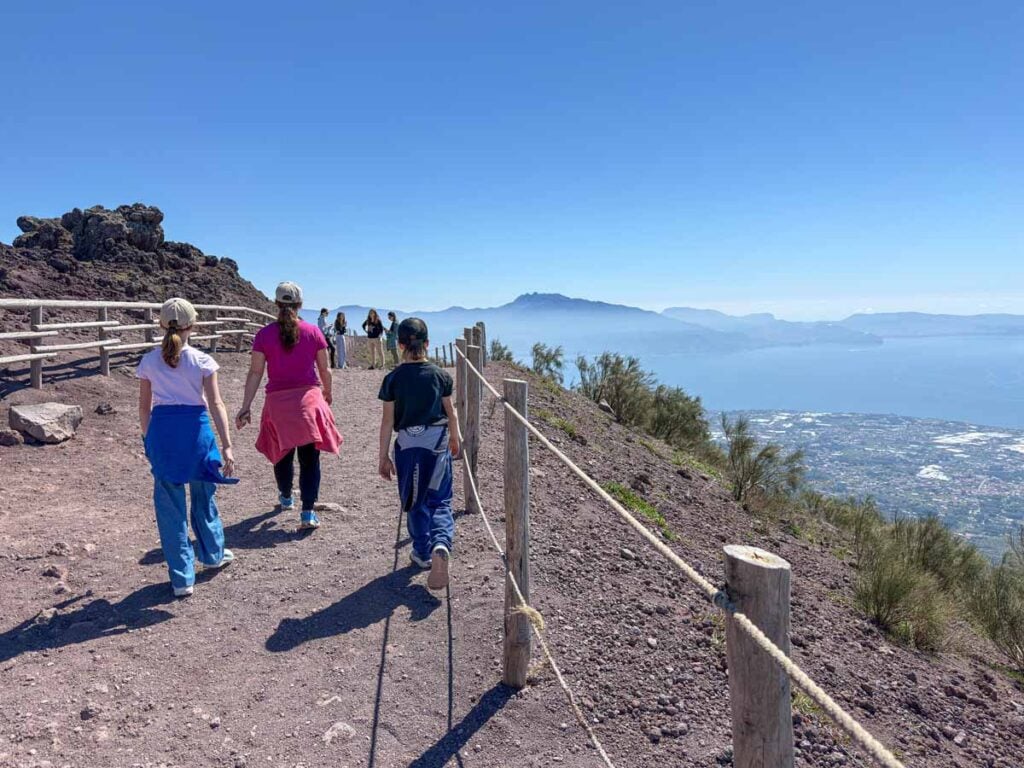
The Gran Cono trail begins uphill and stays that way the entire way to the top. It’s reasonably steep but should be within the capabilities of most visitors.
As the hiking trail climbs Mt. Vesuvius, it passes several viewpoints. The first few stops give amazing views of Naples, the Gulf of Naples and the island of Ischia. Stopping for a few pictures is a great excuse to take a short break if you are getting tired. On a clear day, the views just keep getting better the higher you go.
The Mt. Vesuvius Crater
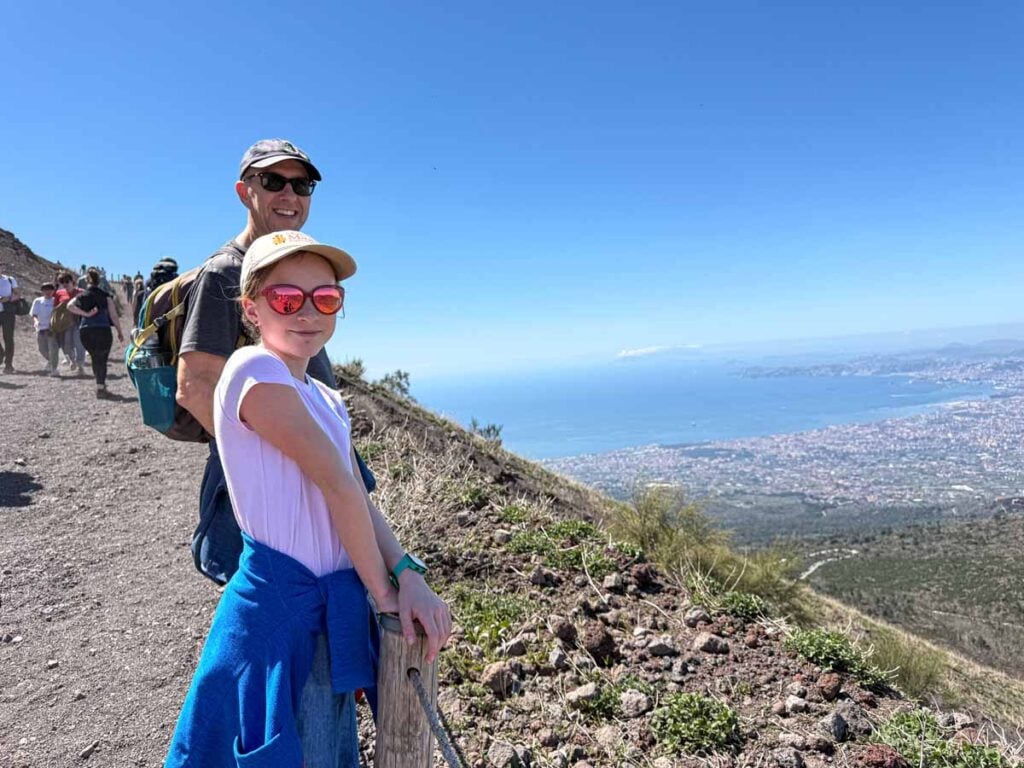
You reach the rim of the crater after 1 km (0.6 miles) of uphill walking. Don’t linger here as this is the busiest viewpoint of them all. It’s less crowded and easier to get a good view further along the trail.
The walking trail along the top of Mount Vesuvius continues for another 700 m (2,300 feet) and there are plenty of viewpoints for the crater along the way. There are also some amazing views of the Pompeii area, the Sorrento Peninsula and Capri.
The crater itself is impressive to look into, and along the inner walls you may even spot some steam vents, which are a reminder that Vesuvius is still a living volcano, even if it is currently in a quiet phase. The official trail reaches a maximum altitude of about 1,175 metres (3,850 feet) above sea level and is roughly 4 km (2.5 miles) in total.
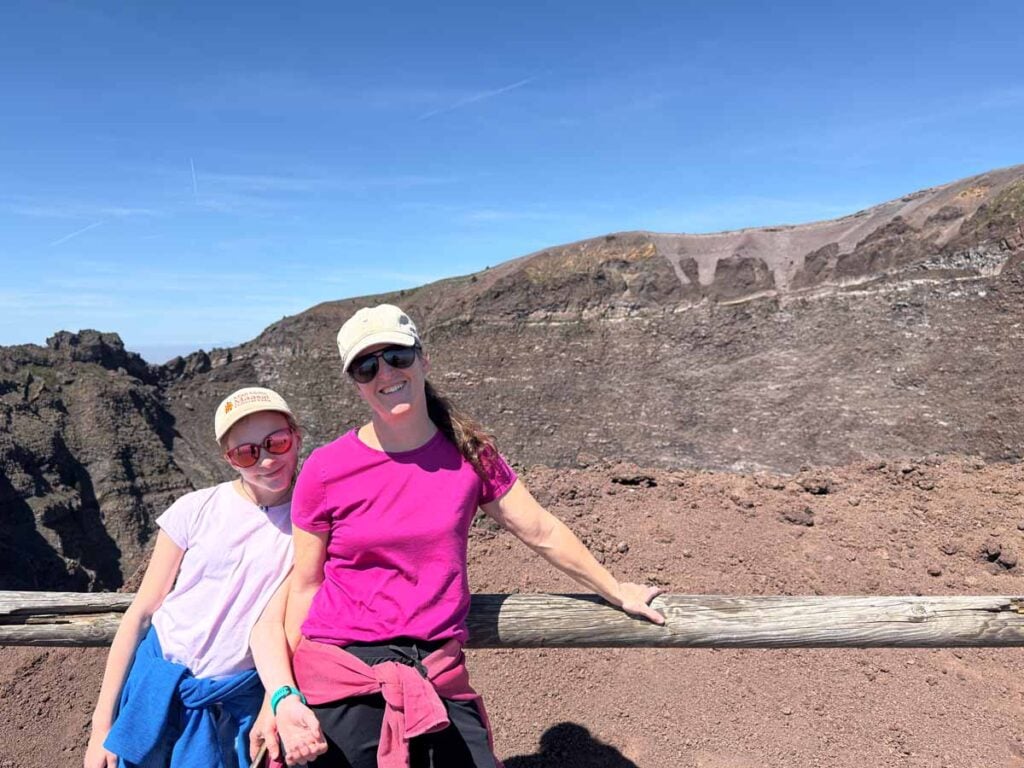
Hiking to the top of Mount Vesuvius was an exciting way to begin our family trip to Pompeii. Standing on the rim of such a famous volcano made the history of this area feel very real, and it got us even more excited to go visit the ruins of Herculaneum and Pompeii next.
Herculaneum
Our next stop was the ancient ruins of Herculaneum, which was just a 5-minute walk from our Ercolano hotel. The remains here were buried by the eruption of Mount Vesuvius in AD 79, and the site is especially well known for its exceptional preservation and vivid picture of daily Roman life.
Before entering the ruins, there is a walkway above the site with great views. It’s a really nice introduction to Herculaneum because you can get an excellent overview of the ancient town before entering.
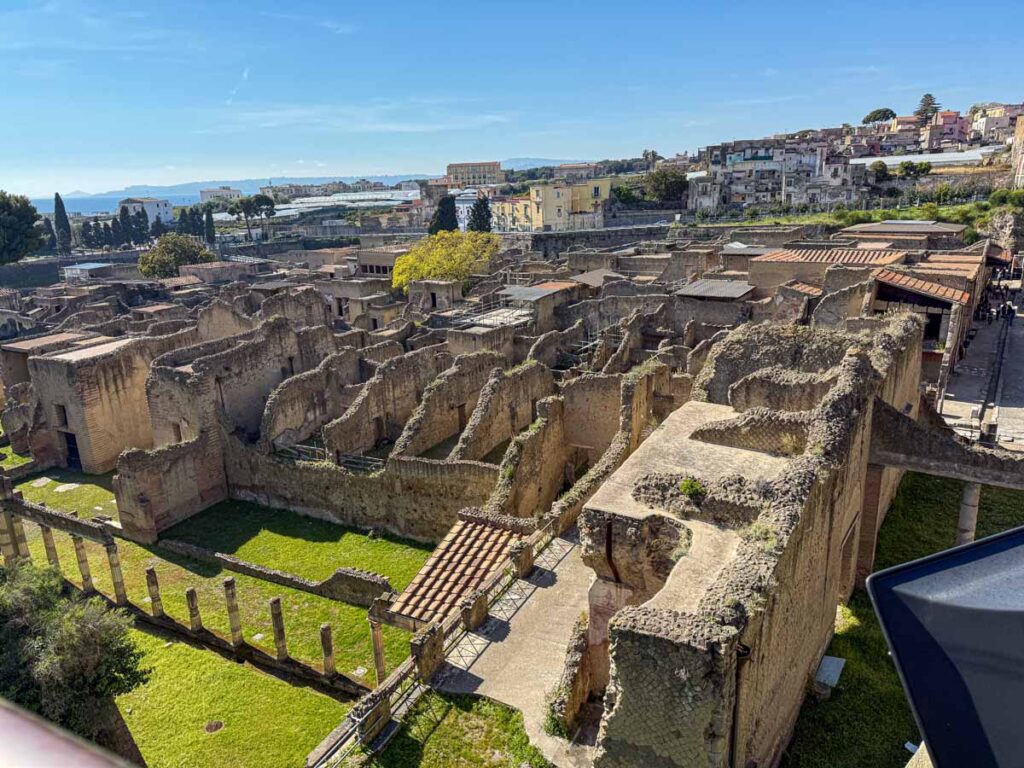
After entering Herculaneum, a long spiral walkway leads down into the ruins and gives you some really nice, elevated views over the site. We always enjoy seeing ancient ruins from above first, as it helps us get our bearings and understand the layout a little better before we start wandering through the streets.
Although Herculaneum is less well-known than Pompeii, it’s incredibly well preserved. In many places, you can still see details like paintings and tile work. It felt so easy to imagine what it was like living in Herculaneum nearly 2,000 years ago.
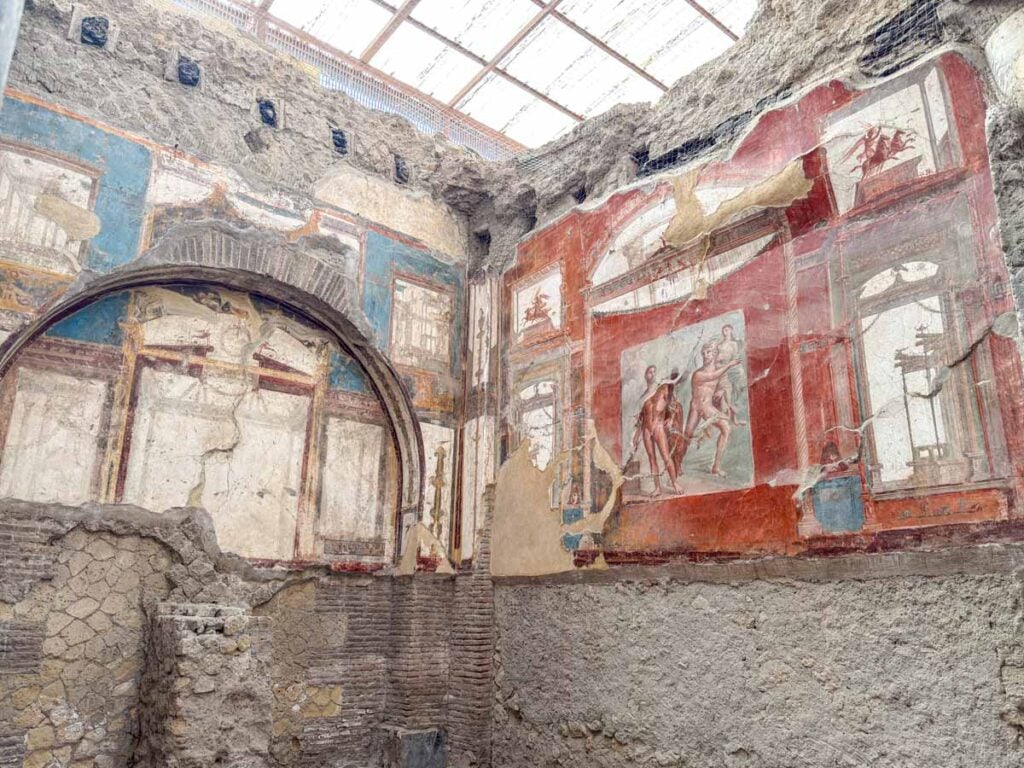
We visited Herculaneum without a tour guide, and unfortunately there were hardly any information signs throughout the site. An audio tour or tour guide would really help bring the site to life and explain what you are looking at.
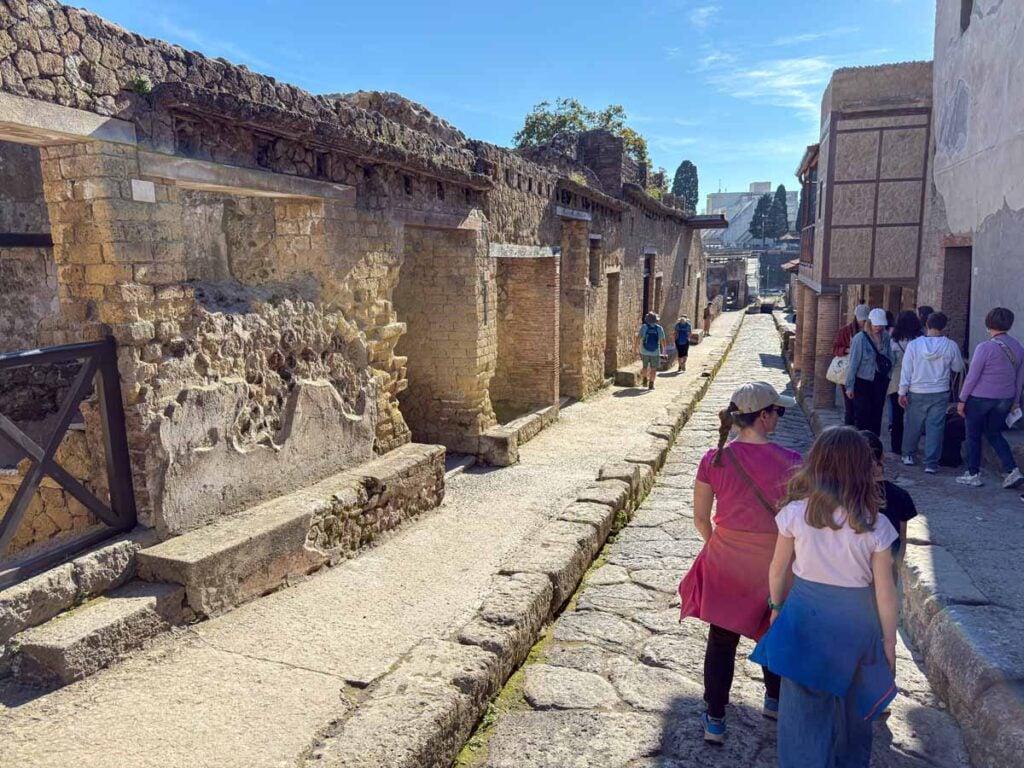
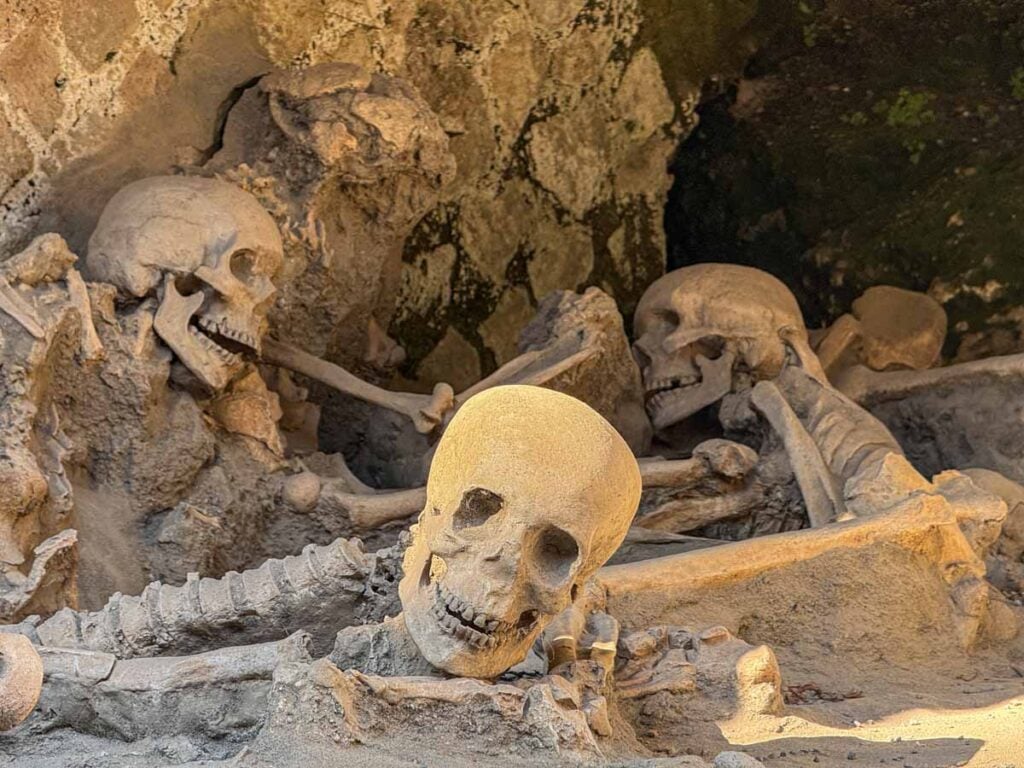
One of the most sobering parts of our visit was seeing the many skeletons in the buildings down by the water. It was a powerful reminder that this wasn’t just an ancient site, but a real town where people were living their lives when disaster struck. These remains were discovered along the ancient shoreline, where around 300 people had gathered in vaulted spaces near the beach, likely hoping to be rescued by sea.
Visiting Pompeii with Kids
We were all excited when the day came for our visit to Pompeii. After reading about it in several books, our kids were finally going to see the world-famous Pompeii.
Pompeii was buried under volcanic ash when Mount Vesuvius erupted in AD 79. The city was lost for centuries before being rediscovered in the mid-18th century. Today, Pompeii gives visitors the rare chance to walk through an ancient Roman city in a way that really does feel like stepping into the past.
Because this was such an important stop on our family trip to Italy, we decided to treat ourselves to a private 2-hour tour of Pompeii. Our guide Daniela met us precisely on time and asked us what our interests were. She went out of her way to ensure we saw the things we wanted to see most.
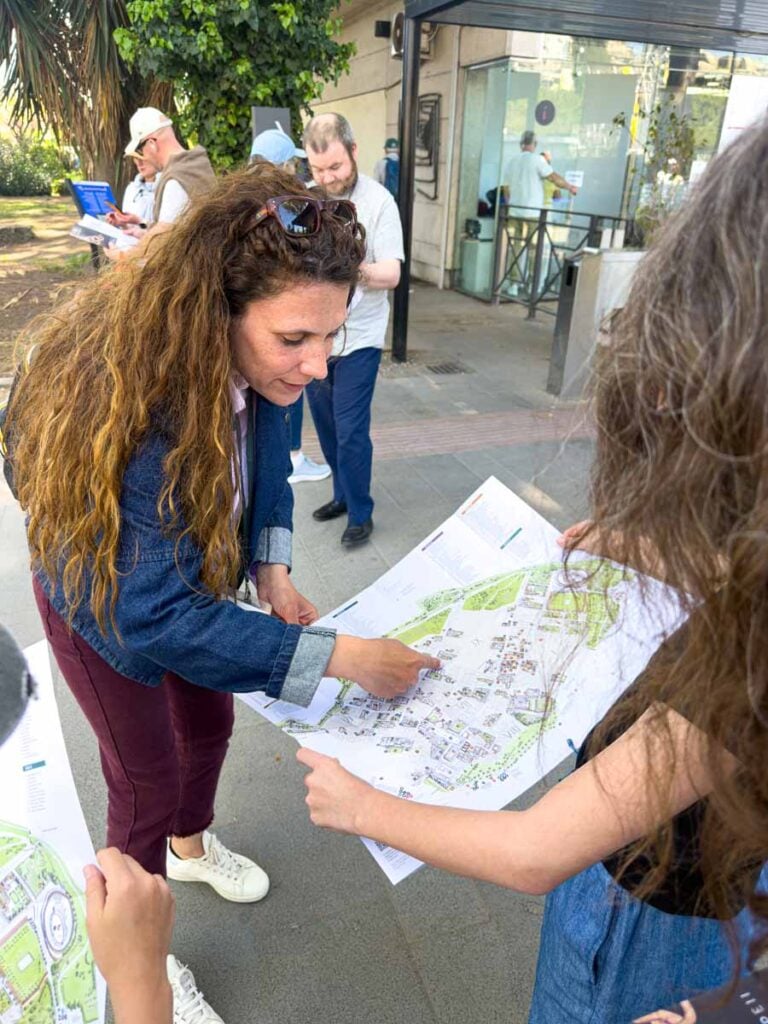
The first thing we noticed during our visit is how big Pompeii is. We had all figured it was going to be a small village, but it was a lot bigger than that. To be honest, we would have been completely lost without a guide. She gave us a comprehensive tour of the main parts of Pompeii, with a special focus on our kids’ interests.
Gladiator School
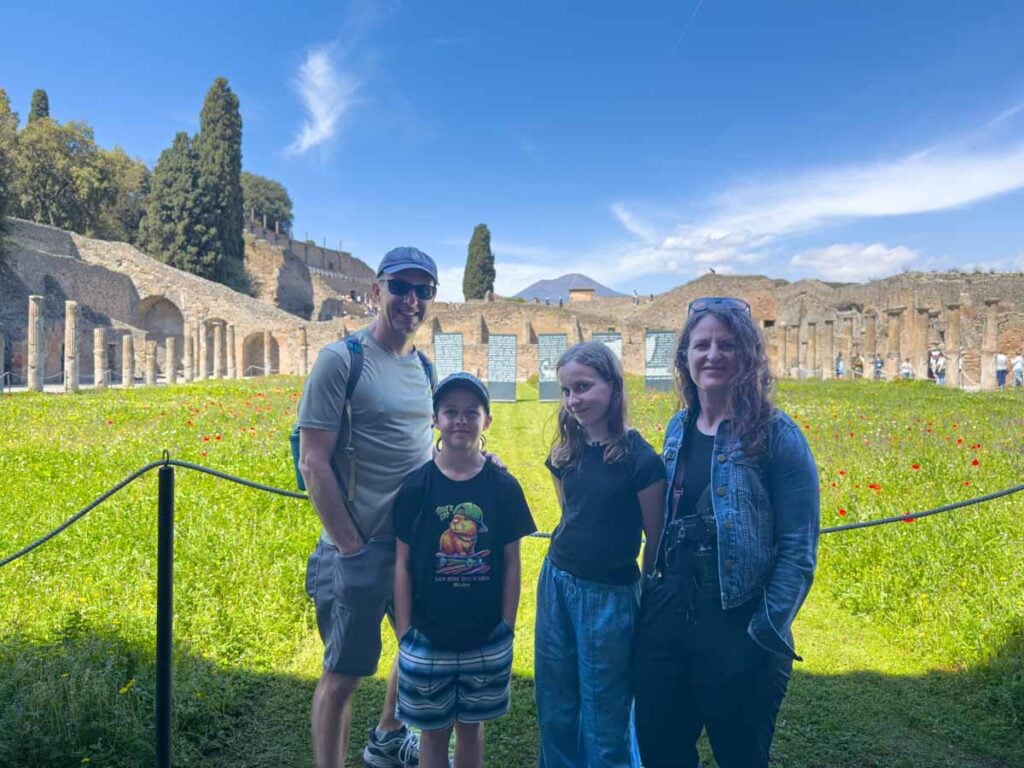
We started with a stop at the gladiator school, a beautiful square with Roman pillars all around and a field full of poppies in the middle. It was a bit sobering to see Mount Vesuvius towering in the distance behind. Knowing that this nearby volcano is the very reason Pompeii was preserved makes it impossible not to think about what happened here.
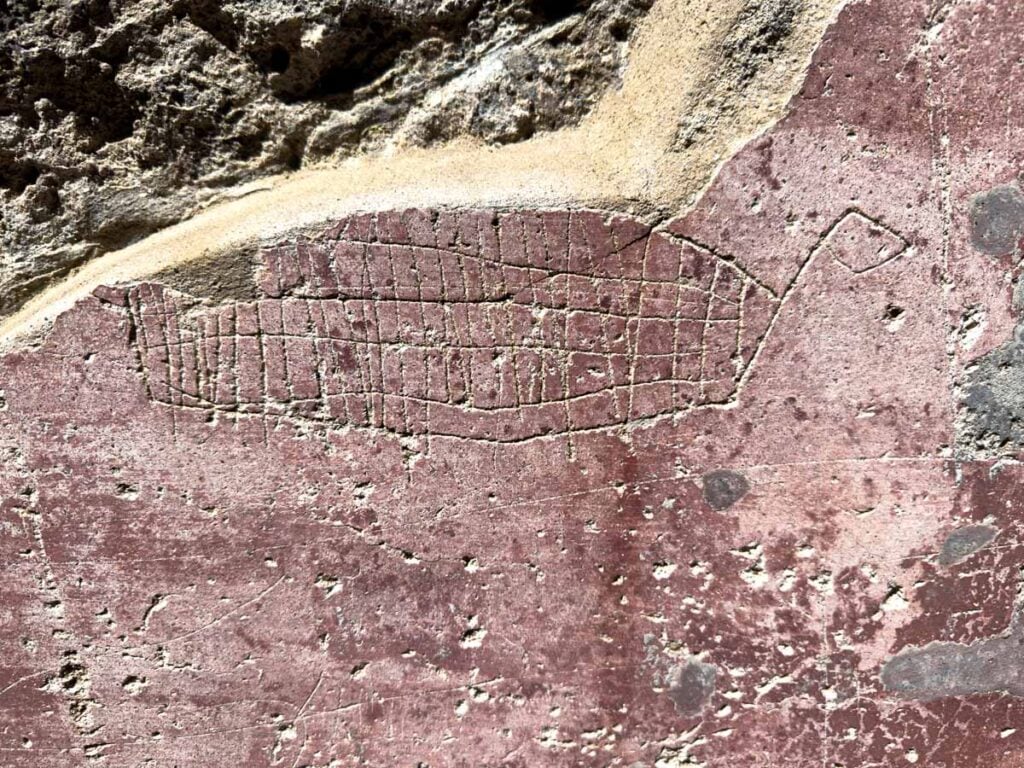
Then we visited the Large Theatre, the biggest theatre in Pompeii, stopping to see original gladiator graffiti along the way. Our kids thought the graffiti was pretty hilarious (I did too), but it’s things like this that make Pompeii feel so real. You are not just looking at old stones or pillars, but at traces of everyday life left behind nearly 2,000 years ago.
Roman Chariots
As we walked along one of the main streets, we could still see grooves from chariot wheels. Seeing the streets, shops, and public buildings helped us understand that Pompeii was once a busy and thriving city, not just an archaeological site.
Then we visited the remarkably well-preserved ruins of three houses from affluent families. It was amazing to see the well-preserved details such as fountains, mosaics, and elaborate artwork on the walls. Pompeii is especially fascinating because so many of these details still survive, giving you a much clearer picture of Roman daily life than you get at many other Roman ruins.
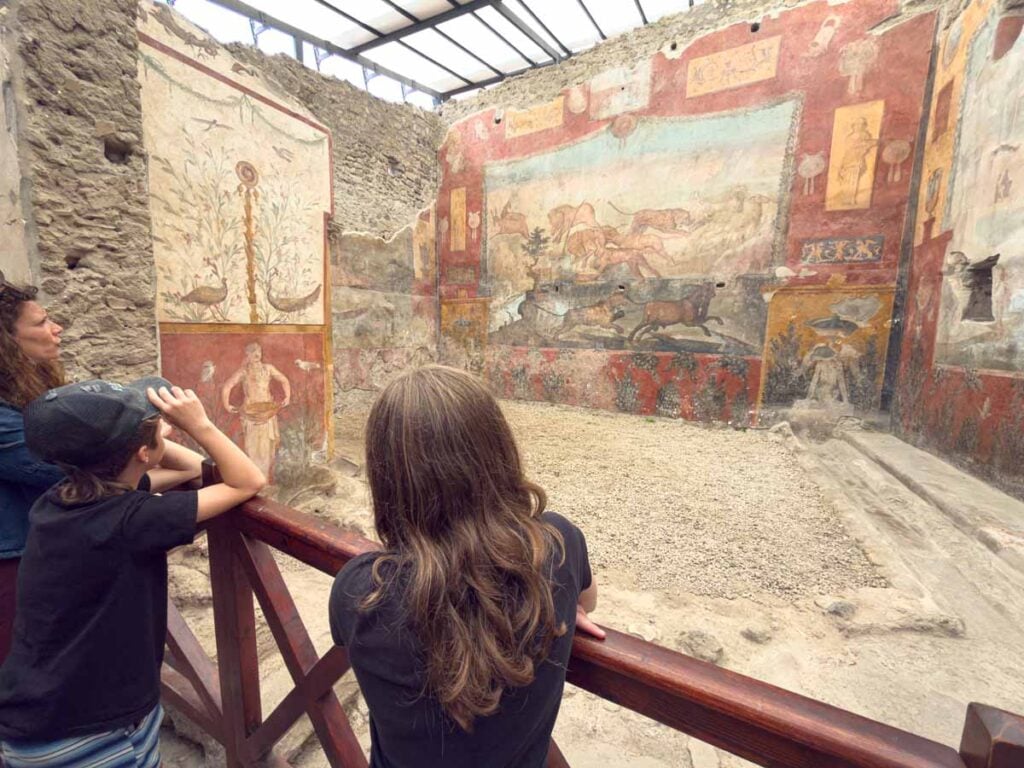
Ongoing Pompeii Excavations
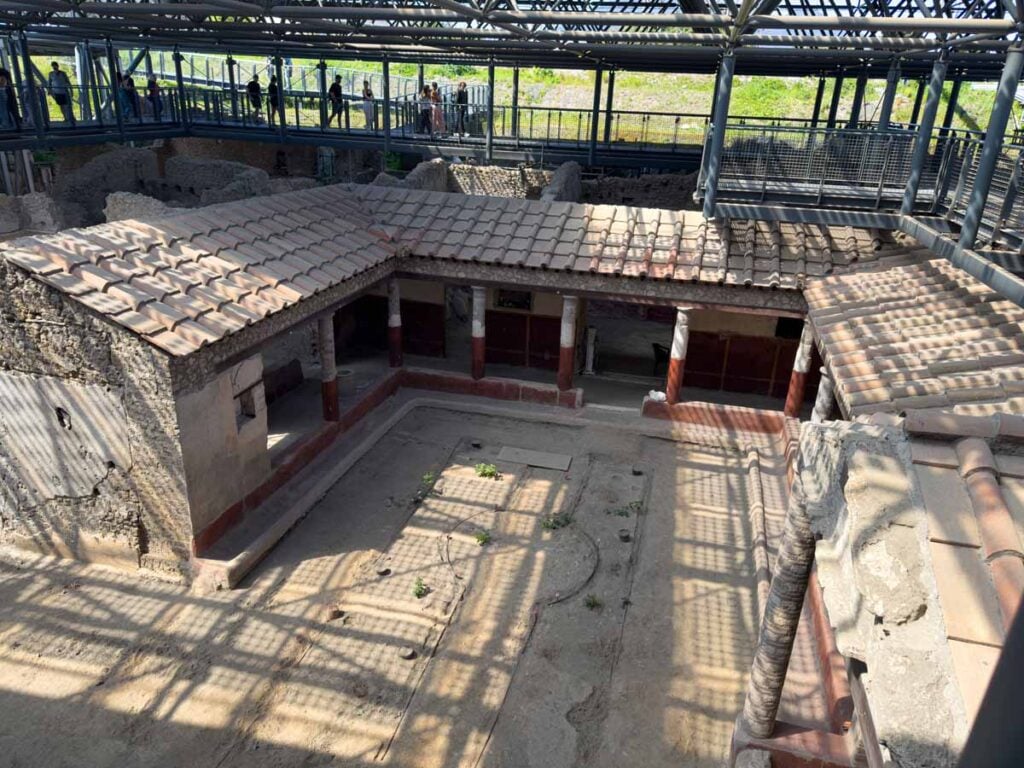
Then, based on interest from our son, our guide took us to the area where archaeologists are actively excavating new areas of Pompeii. It was fascinating to see these modern-day archaeologists at work; they look nothing like Indiana Jones!
We could see structures ranging from fully excavated to still two-thirds full of volcanic ash. It really helped us understand how this city could be so well preserved after nearly 2,000 years. Excavation and research at Pompeii are still ongoing today, with new discoveries continuing to be made.
From there, our guide led us to an amazing viewpoint which allowed us to look down on a large part of Pompeii. It felt so large, yet we knew we were still only seeing part of it.
Plaster Cast Bodies at Pompeii
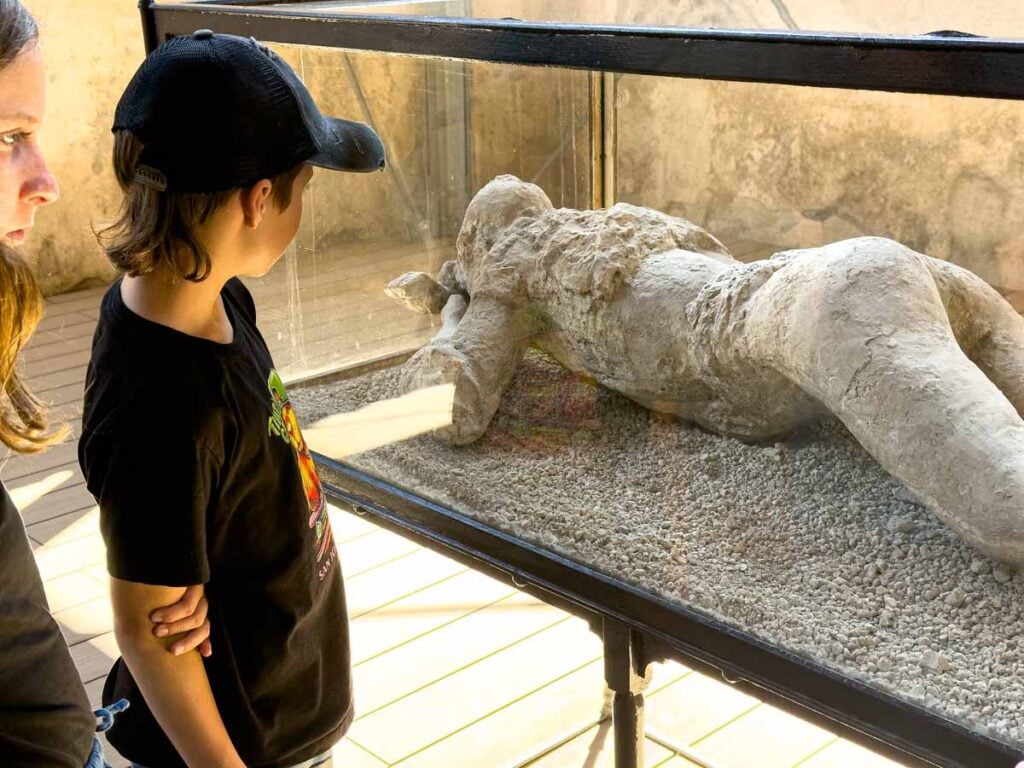
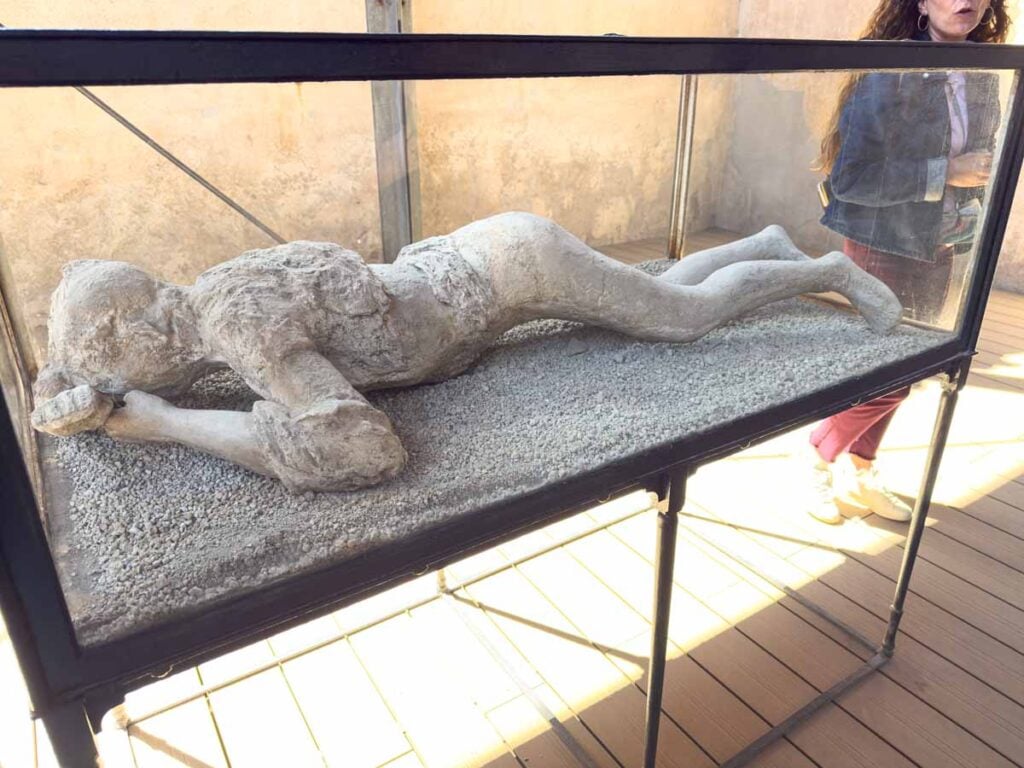
We then followed our guide along the main street of Pompeii, which was pedestrian-only even back then. Our first stop along this road was the bathhouse, which was a very important structure in the city. It was here that we saw our first plaster casts of Pompeii’s victims, which is what our kids wanted to see most.
It was sobering to see the body shapes of people whose last moments were during a volcanic eruption. Seeing some casts with their faces covered or lying on the ground made the tragedy feel very personal. These plaster casts are one of the most memorable parts of a visit to Pompeii, and they make the human tragedy of the eruption feel very immediate.
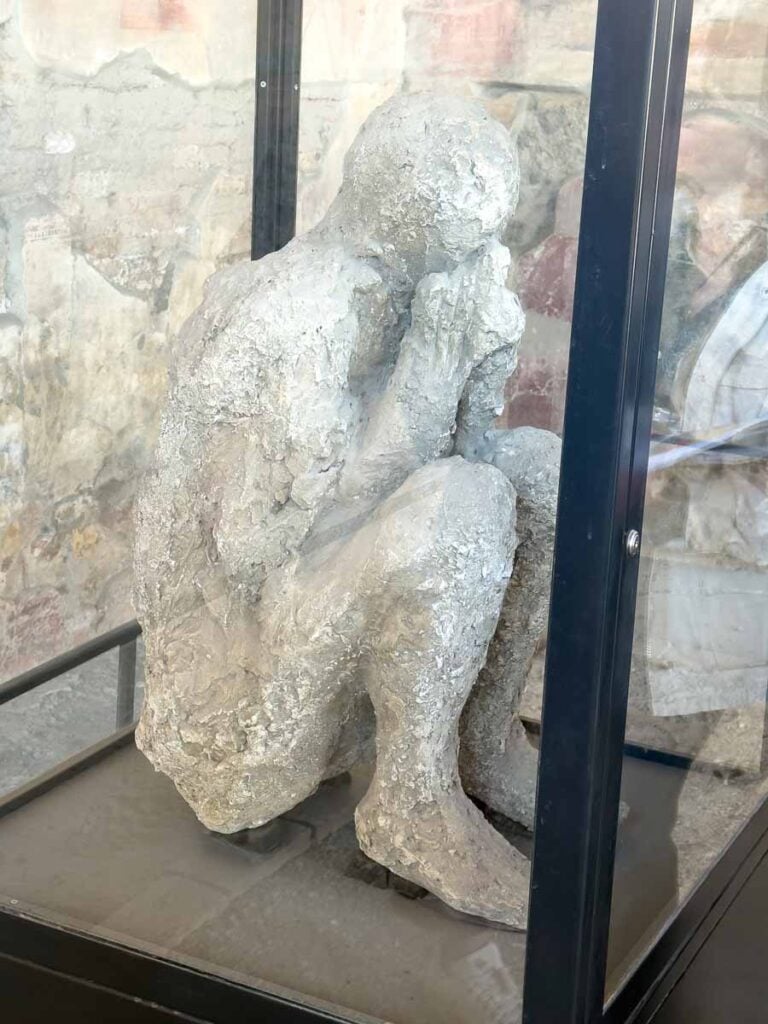
Our last stop on our private tour of Pompeii was the massive main square. Knowing our kids wanted to see more, she took us into the Macellum, Pompeii’s ancient market area, where there were several more body plaster casts.
After saying goodbye to our guide, we made one final stop in the Antiquarium, where many artifacts and statues can be seen. There were also several more plaster body casts in here as well. The Antiquarium was originally built in the 1870s and today serves as a museum space that helps tell the story of Pompeii through artifacts from daily life and casts of the victims.
We were very impressed by our visit to Pompeii with kids. It was much larger than we had expected, and having our own private tour guide really brought the ancient city to life for us. We highly recommend your family visit Pompeii and consider getting a private tour guide too.
Where We Stayed
For our family Pompeii adventure, we based ourselves at the Hotel Herculaneum in nearby Ercolano. We chose this hotel as it was a short walk to the meeting point for our Mt. Vesuvius tour and it was on the doorstep to the Herculaneum archeological site. Pompeii was only a short train ride away, although we ended up sneaking in an amazing 3-day trip to Ischia with kids between the two.
We do not recommend you stay near the Pompeii ruins. It’s not a nice area and nearly every restaurant has horrible ratings on Google. We had lunch at a coffee shop outside Pompeii, and all four of us got food poisoning!
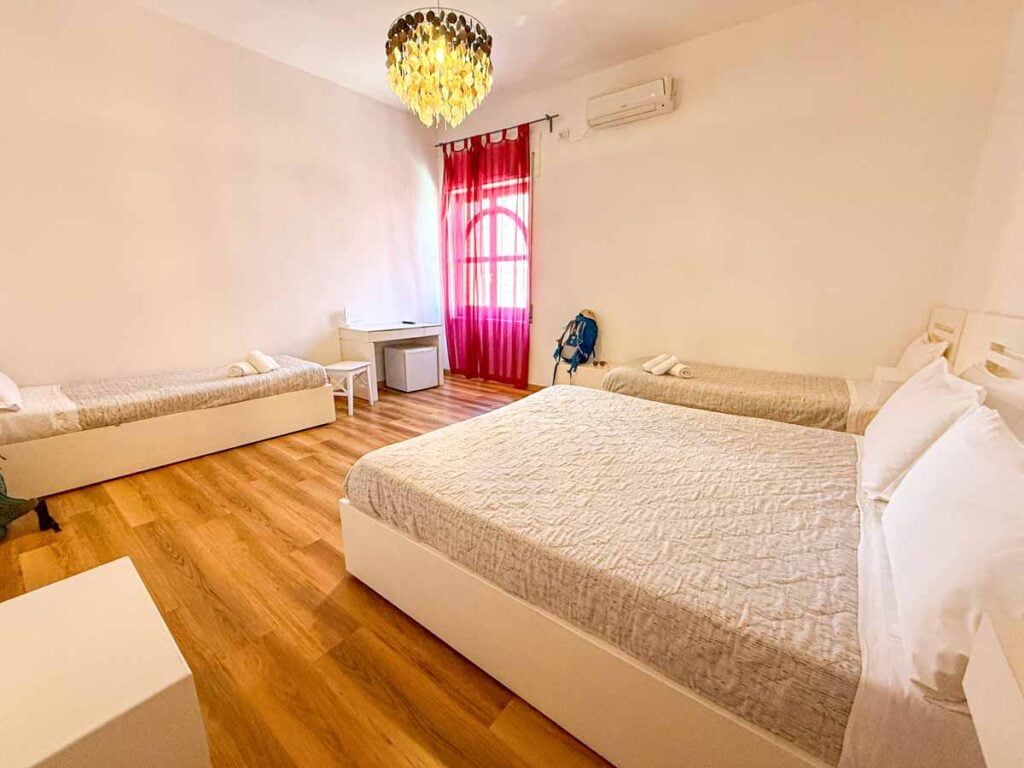
Hotel Herculaneum was a great choice for our family visit to Pompeii. Its location was very convenient, and it had a family room with a queen bed and two singles. The complimentary buffet breakfast was very good, with a large selection of high quality items.
Follow Along on our Family Trip to the Bay of Naples and the Amalfi Coast
We hope you enjoyed reading about our family visit to Pompeii, Herculaneum and Mt. Vesuvius and found it useful for planning your family trip!
To follow along on our recent family vacation to Italy, after Pompeii we travelled to Sorrento to visit the Amalfi Coast with kids. We had two full days in Sorrento, but one day was lost due to our Pompeii food poisoning issue. We made the most of our remaining day by taking a ferry tour along the coastline of the world-famous Amalfi Coast, stopping at the beautiful towns of Amalfi and Positano.
This was our second trip to Italy with our kids. If you are interested in seeing where we went on our first family vacation to Italy, you can see our Italy family itinerary.
Our Travel Journal for Kids
Based on our family travels, our kids helped us design this Travel Journal for Active Kids! This engaging travel journal encourages kids to document their adventures, spark creativity, and stay entertained on the go – grab yours now on Amazon!
